Real-time diagnostics and predictive maintenance for high mill availability

The system provides real-time insight into the mechanical condition of all major units in hot strip and CSP® mills. It integrates vibration analysis, torque monitoring, temperature supervision, oil-film and bearing diagnostics, servo‑valve analytics, and acoustic emission monitoring to detect faults long before they impact quality or cause downtime. Smart signal processing identifies abnormalities such as misalignment, load spikes, contamination or shear‑specific defects. The result: stable rolling processes, higher strip quality, longer component lifetime and reduced maintenance costs.
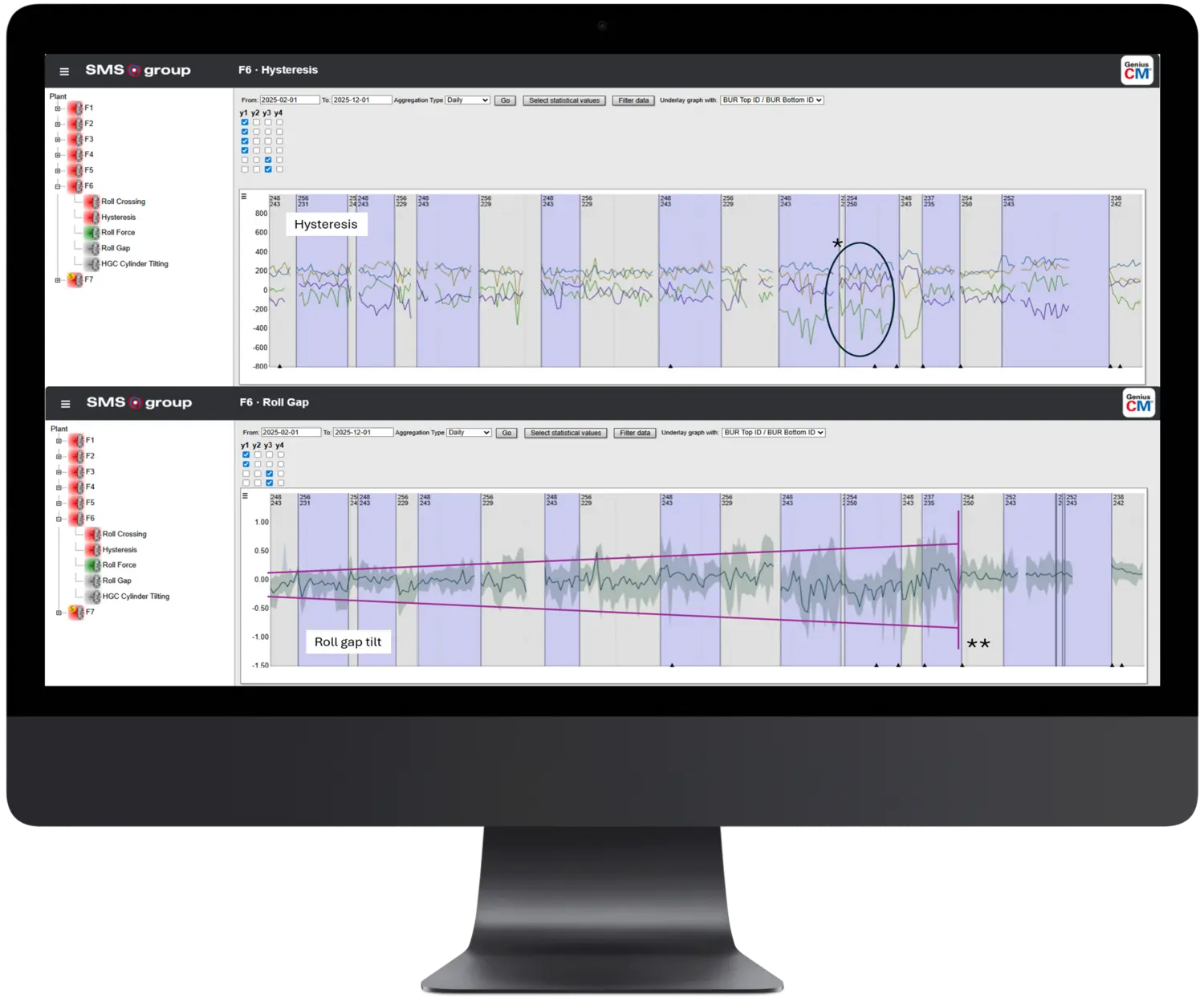
Mill stand module of Genius CM® (Process data indicating increasing problems over time)
* service requested due to increasing rolling stability issues
** change of hydraulic cylinders and reworking of surfaces

Customer challenges addressed

  • Maintaining high mill availability, productivity, and quality
  • Detecting early faults and wear without relying solely on manual inspections or operator experience
  • Preventing unplanned downtime caused by undetected vibration, torque spikes or alignment deviations
  • Ensuring stable strip quality while managing dynamic rolling conditions and process variability
  • Reducing maintenance costs by avoiding unnecessary interventions and targeting the true root causes
  • Gaining clear, data‑driven insights from large volumes of automation and sensor data to support faster decisions

Key features

  • Early fault detection to avoid unexpected failures
  • Plant-wide operating condition monitoring system
  • Increased overall equipment availability and process stability
  • Extended component lifetime through reduced wear and better load control
  • Predictive maintenance and Cost savings due to avoidance of unnecessary or too-frequent maintenance and repairs
  • Higher and more reliable product quality with special process optimization tools

Highlights

  • Mill Stand Assessment

    Deep alignment analysis for stable rolling

    The Mill Stand Assessment builds on conventional condition monitoring by continuously tracking roll forces, axial roll‑crossing forces and hysteresis to detect deviations from stable mill behavior. 

    Using existing automation data and model‑based calculations, it produces statistical KPIs and early warnings that reveal developing rolling‑stability problems before they escalate. When these trends appear, SMS group experts provide an in‑depth alignment analysis of the mill stand, evaluating CVC® block and chock geometry and correlating stand and chock measurements to determine the true cross‑angle between backup‑ and work‑roll axes. 

    Excessive cross‑angles generate abnormal axial forces, accelerate wear, impair CVC® shifting and destabilize strip steering, making accurate quantification essential. The result is a holistic diagnosis that reconciles roll‑shop and mechanical findings and pinpoints root causes such as misaligned housings or problematic chock combinations. 

    Mill Stand Monitoring
  • Torque monitoring

    Drive load tracking for spindles and gear units

    Torque Monitoring provides online measurement of spindle and main-drive torque, capturing load peaks, torque fluctuations and long-term load collectives. It measures top and bottom spindle loads separately to identify asymmetry, overload conditions or improper pass schedules. 

    The system helps evaluate spindle safety factors and reveals mechanical stress during acceleration phases, mill bite or cobble events. The data supports optimization of rolling setups, ensuring safe operation within drive limits while preventing spindle or gearbox failures. Long-term trending also enables predictive replacement planning and supports production diagnostics. 

    Torque measurement ring
  • Servo valve monitoring

    Hydraulic valve dynamics and stability

    Servo Valve Monitoring analyzes the dynamics and functional integrity of hydraulic servo valves used in AGC, steering and other control systems. Two diagnostic instances per valve evaluate the valve’s own feedback behavior and the cylinder response. 

    The system identifies delayed valve reactions, hysteresis, internal leakage, contamination effects and deviations in valve dynamics. Temperature and flow parameters help characterize hydraulic conditions. By detecting declining performance early, the module prevents control instability, strip quality defects and hydraulic failures. It ensures consistent actuator behavior and reliable mill automation. 

  • Shear monitoring

    Few revolution gear and bearing diagnostics

    Shear Monitoring is designed for crop, pendulum and drum shears, which operate with only 1-2 revolutions per cut - too few for conventional bearing or gearbox analysis. Using synchronized vibration and acoustic emission sensors, the system combines multiple cutting cycles and applies different methods to evaluate gear-tooth condition, bearing health and shaft behavior.

    It compensates high impacts from material cutting and identifies anomalies such as tooth damage, bearing defects or misalignment. Angle‑based analysis and profile trending detect progressive wear long before failure, reducing unplanned downtime and enabling safe shear operation. 

Let's get in touch!