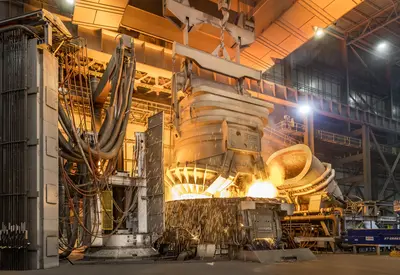
Electric arc furnaces (EAF) have played an essential part in the minimill success story over the past decades. Based on the availability of steel scrap and inexpensive electricity, electric steelmaking offers an energy-efficient and cost-effective alternative to integrated steel production, even in locations away from traditional industrial regions.
As scrap availability increases and green energy becomes more accessible, EAF technology will continue to play a central role in the years to come in achieving sustainable steel production while satisfying growing demands. Nevertheless, the requirements for electric arc furnaces are changing and becoming more challenging, both inside and outside the scope of minimill projects.
Flexible raw material input
EAFs are uniquely suited to processing diverse raw materials, including scrap steel, direct reduced iron (DRI), and hot briquetted iron (HBI). This flexibility ensures their adaptability to varying resource availability levels. For example, while scrap availability in China is expected to surge by the 2040s, the US and Europe are already benefitting from reliable scrap resources and stringent environmental regulations. By 2050, experts expect a total of up to 1.4 billion t of scrap to be available each year.
When recycling steel scrap in an EAF, tramp elements such as copper, tin, and lead cannot be eliminated by the melting process, which in turn compromises the final product’s quality by reducing ductility and causing brittleness. To produce high-quality steel from scrap, advanced sorting, blending, and processing techniques are essential for meeting stringent quality standards and thus enabling premium-grade steel production.
For a backward analysis of scrap composition, SMS group’s X-Pact® Sampler provides reliable operation for sampling, optimizing the charge mix, and improving yield thanks to the process control system. This advanced robotics application automates liquid steel sampling, including sample handling and lance deformation compensation, and is fully integrated into the main automation system.
When using HBI or DRI as input material, the steel quality is more predictable and shows a more uniform composition, with minimal impurities. With 90% to 94% of metallic iron content, DRI and HBI are ideal for producing high-quality steel, but this requires additional energy input to reduce the iron oxide, melt it, and remove impurities.
In many projects, we see the need for greater flexibility regarding input materials, ranging from 100% scrap to 100% hot briquetted iron / direct reduced iron (DRI). This requires more electrical energy and advanced integration with existing equipment, while at the same time maintaining productivity levels through a balance of mechanical and electrical design. An example of this flexible raw material input is the new AC EAF we are supplying to Stahl-Holding-Saar (SHS). This 185 t EAF, with a transformer capacity of 300 MVA, will be capable of processing a flexible mix of scrap and cold DRI/HBI and will contribute significantly to SHS’s strategic plan to reduce carbon emissions by utilizing a mix of natural gas and hydrogen. The plant will produce various steel grades, including bearing steel and spring steel, enhanced by SMS group’s advanced automation technologies such as X-Pact® Autotap and Genius CM for predictive maintenance.
The three 180 t EDGE DC EAFs for Stegra in Sweden are also designed for hot and cold DRI charging. DRI will be supplied continuously from the directly linked Midrex plant. Based on these input materials, Stegra will produce advanced automotive steel grades. The EAF will be part of the world’s first green steel plant, setting a new industry benchmark.
Energy supply
Energy-intensive steelmaking processes require innovative solutions to minimize consumption and maximize efficiency. A key focus area is the comparison between DC and AC technologies, where SMS group’s DC EAFs stand out due to their superior energy efficiency, operational cost savings, and environmental benefits. The natural stirring effect in the DC EAF ensures temperature and chemical homogenization, reducing “power-on” times and electrode consumption. Additionally, the longer arc of the DC design enhances heat transfer, further lowering energy requirements while reducing flicker. This design also improves the operator environment, cutting noise levels by up to 40% compared to AC designs. The bottom electrode pins, engineered for extended lifespans of up to 2,000 heats, minimize handling costs and contribute to operational reliability.
Complementing this technology is SMS group’s X-Pact AURA platform, which leverages IGBT (insulated gate bipolar transistor)-based power electronics to address challenges in weak grid environments. Designed with modular architecture, X-Pact® AURA delivers maximum efficiency, reliability, and dynamic response, with power ratings ranging from 5 to 350 MVA. This innovative platform improves power quality parameters, achieving a power factor above 0.95 and a 30% reduction in flicker against most modern compensation systems. Its modular design enables seamless integration into high-power melting units, even within constrained grid conditions, setting new benchmarks in energy-efficient steelmaking.
Integration of AURA-based DC EAF technologies will be central for the project of Hybar LLC in Osceola, Arkansas, USA. Here, Hybar and SMS are advancing green rebar production through their collaboration on the first CMT (continuous minimill technology) minimill. X-Pact® AURA enhances energy efficiency and sustainability, utilizing up to 100% renewable energy from a solar park. The minimill is expected to reduce its carbon footprint by 35% compared to conventional minimills. It will operate on solar energy for up to twelve hours daily, supported by advanced energy management systems.
Capacity
Just as the input materials and the type of energy supply vary, the capacity of electric arc furnaces also differs in many projects today. Long products minimills remain “market mills” with limited capacity (0.3 to 1.0 million t/year) based mainly on 100% scrap. One example is the new electric arc furnace for the CMT minimill for Future Forgeworks in Australia, which will have a capacity of 350,000 t/year and feature an AllCharge EAF that is focused on efficiency and sustainability and equipped with technologies to minimize emissions and enhance safety.
In contrast, minimills for flat products challenge the capacity of conventional mills with more than 3 million t/year. We are ready for large-scale EAFs, as shown by the reference facility at SSAB. The 190 t AC EAF will be one of the largest EAFs globally, with an upper shell diameter of 9.3 m. This underscores the trend toward larger installations, also driven by the need to replace the traditional BF-BOF route with electric steelmaking. This project is pivotal in handling large amounts of direct reduced iron, requiring more electrical energy and advanced integration with existing equipment. SMS group’s design enables the charging of scrap and cold DRI from 0% to 100%, maintaining productivity through a balance of mechanical and electrical design, supported by modern solutions such as an automatic slag door and digital scrap logistics.
AC EAF
- Lower initial cost
- Greater production flexibility
- Simpler start-up/shutdown
- Higher energy use and electrode wear