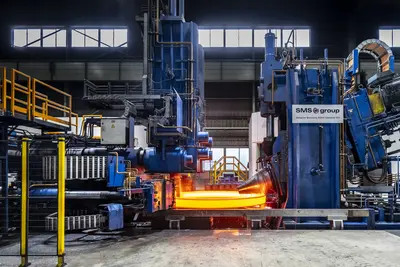
Seamless rolled rings are hidden yet essential components at the core of jet engines and airframes. As structural backbone elements of modern aviation, they must perform reliably under extreme loads and temperatures while meeting the highest standards for mechanical strength, durability, and dimensional precision.
Rising production volumes and increasingly complex materials are placing greater demands on rolled ring manufacturers to improve efficiency without compromising quality. SMS group addresses this challenge with a versatile portfolio of radial‑axial ring rolling machines (RAW). Alongside proven central hydraulic systems for heavy applications, electrohydraulic (EH) drives have emerged as a precision-focused solution, particularly for civil aerospace requirements, supported by advances in drive and digital control technologies.
Choosing the right tool
For extremely large components such as rings for wind turbines or nuclear infrastructure, classic central hydraulic systems are still the preferred solution, providing the immense, continuous forces required to shape components of exceptional size and weight.
When processing high-value, temperature-sensitive aerospace alloys such as titanium or nickel-based superalloys, the focus shifts to precision. Electrohydraulic drive systems combine hydraulic power with advanced electronic control, delivering both force and accuracy. Even in high-output, 24/7 production environments, EH technology provides a clear competitive advantage.
Seamless rolled rings in aerospace
Seamless rolled rings play a critical role in aircraft engines and structures. The ring rolling process creates a continuous grain flow that follows the ring geometry, significantly enhancing fatigue resistance and structural integrity compared with welded or machined rings—an essential factor for safety-critical aerospace components.
In aerospace engineering, rolled rings are used in turbine components, bearing rings, and engine casings, among other applications. These parts must withstand extreme mechanical loads and temperatures while maintaining tight dimensional tolerances throughout their service life.
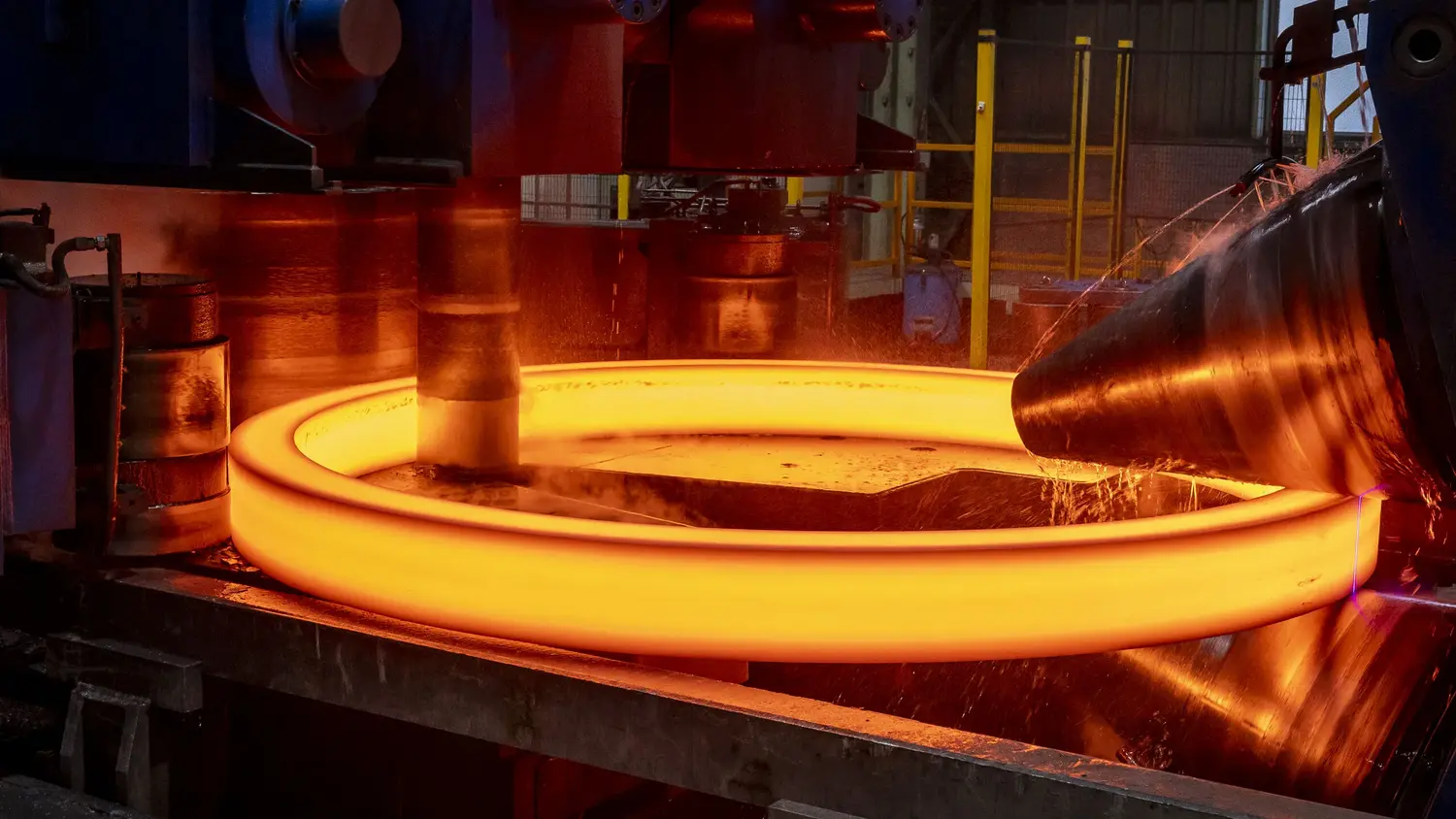
Titanium alloys and nickel-based superalloys dominate many aerospace applications due to their excellent strength-to-weight ratios and thermal resistance. However, their demanding forming behavior requires precisely controlled rolling conditions. SMS group’s radial‑axial ring rolling machines are designed to meet these challenges. By controlling radial and axial forming simultaneously, they enable precise geometries, excellent material properties, and efficient material use—especially important when processing high-cost aerospace alloys.
Five benefits of electrohydraulic drive technology
With its electrohydraulic drive technology, SMS group has introduced a highly efficient power-on-demand concept that aligns energy consumption directly with the ring rolling process. Instead of a single central hydraulic system, each major machine axis is equipped with a compact electrohydraulic drive unit that combines a servo motor and hydraulic pump and is mounted directly on the axis. This decentralized architecture generates power only where and when motion occurs, fundamentally changing how energy is delivered within the machine.
Because electrohydraulic drives operate only during movement, idle energy consumption is minimized. During production, this reduces energy use of the rolling axes by approximately 25 to 50%. During downtime, the drives stop completely without affecting readiness. Reduced heat generation enables smaller cooling systems that operate less frequently, lowering overall energy consumption and minimizing wear on cooling components.
Decentralized electrohydraulic drives greatly reduce the amount of hydraulic oil required. While conventional systems often need around 10,000 l, comparable EH-equipped machines operate with local circuits totaling only about 900 l—a reduction of up to 90%. Fewer hydraulic lines and components improve accessibility and simplify maintenance throughout the machine’s lifetime.
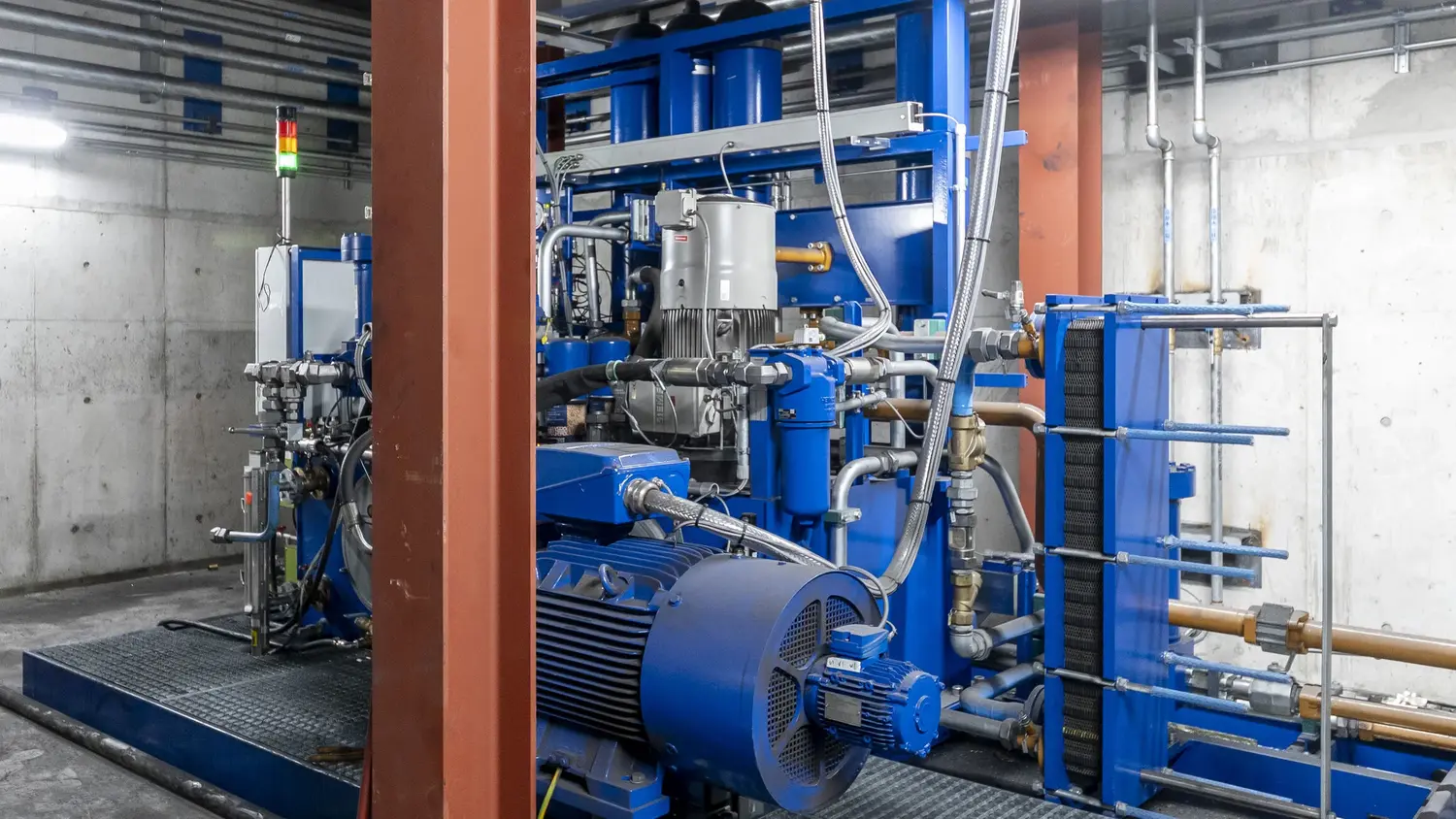
The decentralized pump units run only during axis movement, cutting noise emissions by 15 to 30% and typically keeping sound levels below 85 dB(A). Lower energy consumption, reduced cooling demand, and smaller hydraulic circuits directly reduce indirect CO2 emissions, while quieter operation improves shop‑floor conditions and reduces the need for acoustic shielding.
Eliminating central hydraulic stations, long piping, and servo valves on the main axes simplifies the overall system architecture. Smaller, localized hydraulic circuits reduce the handling effort for operating fluids and lower environmental risks associated with storage, transport, and disposal. The result is enhanced long‑term reliability and reduced maintenance effort.
Without a central hydraulic station, machines with EH drives require less installation space and fewer auxiliary systems. Preassembled drive modules can be integrated directly into the machine, significantly shortening on‑site installation and commissioning. This is especially valuable during retrofits, minimizing production interruptions. Combined with lower energy use, reduced noise and heat, minimal hydraulic oil, and lower maintenance requirements, EH technology delivers a clearly reduced total cost of ownership while maintaining high operational reliability.
Precision control for demanding materials
Aerospace alloys such as titanium and nickel-based superalloys are highly temperature-sensitive, requiring fast positioning and precisely controlled forming forces within narrow processing windows. Electrohydraulic drives provide this precision through servo motors and variable pump displacement. Torque, speed, and hydraulic flow are continuously adjusted in real time to satisfy process requirements.
EH systems provide rapid positioning followed by finely regulated rolling forces, with smooth, dynamic transitions. Integrated pressure and position sensors provide continuous feedback, ensuring stable forming conditions. This precise control improves dimensional accuracy, surface quality, and process reproducibility, enabling tighter tolerances and reducing input weight and overall production costs.
Digitalization for ring rolling process enhancement
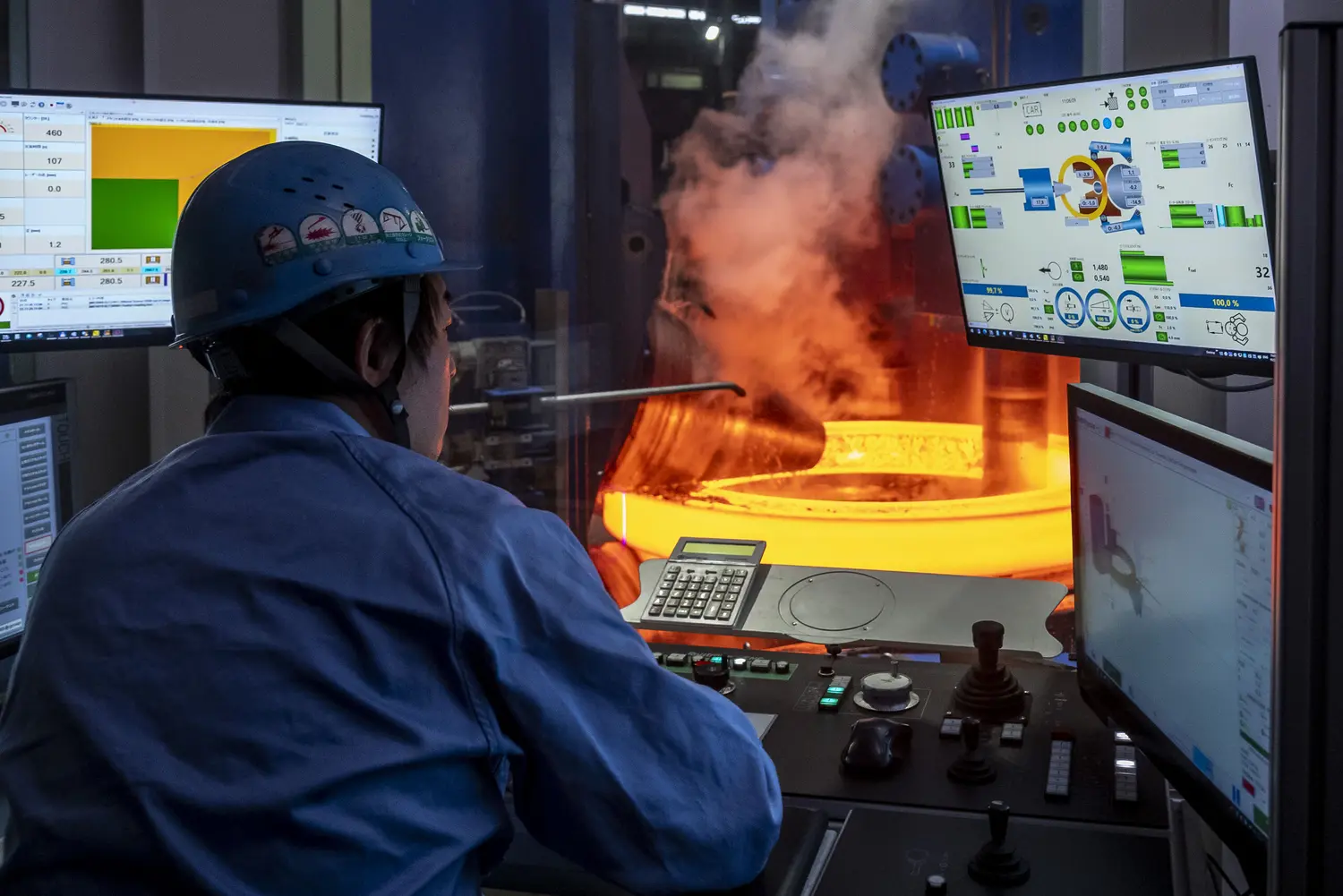
Beyond mechanical advances, digital technologies play an increasingly important role in modern ring rolling, supporting both process planning and automated operation. The CARWIN control system monitors and optimizes the entire rolling process, verifying target parameters and adjusting machine movements in real time to maintain stable forming conditions.
Process planning begins long before the first ring is rolled. The engineering tools ROLLTECH Rings and ROLLTECH Profiles calculate optimal rolling strategies based on geometry, material, and machine capabilities, reducing trial runs and improving material efficiency. ROLLTECH Real Process Simulation (RPS) uses FEM-based virtual modeling to simulate the complete rolling process. Engineers can analyze material flow and forming forces in advance, refining strategies before production.
The CARTI software optimizes the rolling of titanium and other low-thermal-conductivity materials using alternating radial and axial strategies, preventing local overheating and reducing high-cost material scrap. Digital monitoring tools such as SMS‑Metrics provide real‑time visibility into machine and process performance, while Smart Alarm systems support faster and more structured fault diagnosis.
EH technology vs. conventional systems
- Energy savings of up to 50% thanks to power-on-demand
- 90% reduction in hydraulic oil consumption
- Footprint reduced by a factor of 6 (no cellar required)
- Low maintenance (modular, fewer parts)
- 15–30% lower noise levels (<85 dB(A))