SMS group is proud to announce that the project “Developing and Enabling H2 Burner Utilization to Produce Liquid Steel in Electric Arc Furnaces (DevH2forEAF), coordinated by RINA, has achieved a significant milestone towards a sustainable steel production.
This ground-breaking initiative, funded by the European Union's Research Fund for Coal and Steel research program under grant agreement number 101034081, focuses on the development of an innovative multi-fuel burner for electric arc furnaces (EAF). The burner is designed to efficiently utilize a mixture of natural gas and hydrogen (up to 100%) and represents a pioneering solution in the steel industry.
The primary goal of DevH2forEAF is to develop a revolutionary SMS burner capable of using hydrogen from 0 to 100%, making it the first of its kind in an EAF. This technology aims to facilitate a complete transition from fossil fuels to hydrogen, contributing to a more sustainable steel production process aligning with industry goals to reduce environmental impact and foster innovation.
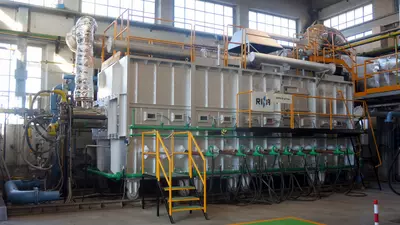
The project achieved a crucial milestone with the first recent test conducted at RINA experimental combustion station in Dalmine, Bergamo (Italy). The test resulted from a complete series of trials, progressively increasing the burner's power from 1 MW to 3 MW and the H2 fraction from 0 to 100%. This success validates the burner's ability to operate in varying conditions, marking a significant step toward industrial-scale implementation.
The project, began with the development of thermodynamic and kinetic models, followed by extensive and advanced computational fluid dynamics (CFD) simulation. Following the successful laboratory tests, the burner will be tested in two industrial EAF: Ferriere Nord in Osoppo (Italy) and Celsa in Barcelona (Spain).
SMS group designed the burner to seamlessly transition from natural gas to a hydrogen mixture, reaching up to 100% hydrogen utilization. The SMS burner, meticulously designed and manufactured, demonstrates exceptional mechanical and thermal resistance in severe operating conditions. RINA set up the combustion chamber (with a section of 2 x 2 m and a length of 7.5 m), designed and managed the whole experimental trials. Nippon Gases contributed by designing and realizing thefuel supply regulation system (FSRS) for natural gas/H2 , blending up to 100% hydrogen; in addition, as hazard study leader, Nippon Gases defined the safety prescriptions for all the different testing sites and supplied hydrogen through special new hydrogen tube trailer.
SMS group, RINA, Nippon Gases, as well as all the DevH2forEAF project partners (RWTH Aachen University, Ferriere Nord, Celsa and AFV Gruppo Beltrame) are committed to showcasing the maturity of the technology and its potential to support the transition from fossil fuels to hydrogen in EAF processes.