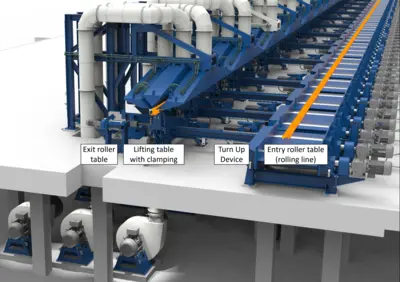
Due to the high contact stresses between the railway vehicle wheels and the rails, rails are subject to wear and fatigue damage caused by the ‘roll contact force,’ as it is known. Rails are the main cost driver when it comes to railway network maintenance. Rail manufacturers are making efforts to improve rail durability by optimizing the microstructure in the rail head resulting in head-hardened rails (HHR) that have a significantly longer service life.
In almost all rail manufacturers’ production facilities, this requires an inline heat treatment procedure directly after rail hot rolling. The main advantages of this arrangement are the exploitation of the heat from the rolling process and the resulting shorter process chain, as the rail does not need to be heat-treated separately.
Rail head hardening with innovative RailCool® Air
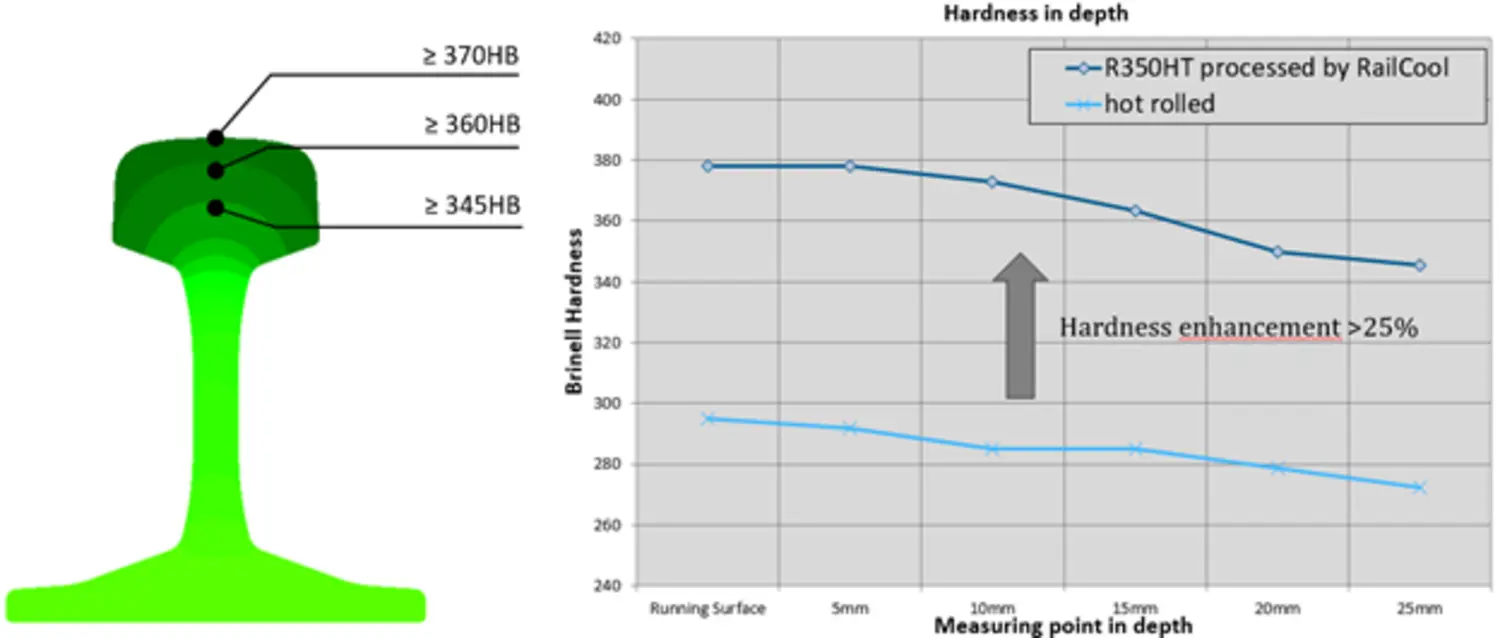
RailCool® Air is an innovative product developed by SMS group for rail production, eliminating the need for water and chemical additives and thereby improving the efficiency of the process. RailCool® Air is designed to optimize the material’s microstructure so that the mechanical properties of the rail heads, including the hardness and tensile strength, can be considerably enhanced. RailCool® uses air to ensure consistent and reproducible cooling that creates a fine pearlitic microstructure in the rail head. Unlike water cooling, which can often result in excessive cooling, RailCool® provides temperature-controlled “soft cooling” at the optimal cooling rate for each steel grade according to the relevant rail standards.
A major benefit of air cooling compared with other methods (such as spraying water, immersion in polymer, etc.) is the ability to precisely measure temperatures and, if necessary, adapt the cooling rate accordingly to ensure ideal conditions. In conventional rail manufacturing, a continuous pass-through cooling process with water is often used. The problem here is that the tail end of the rail enters the cooling process much later than the rail head end, resulting in sections of the rail cooling down before the production sequence can be completed. To compensate for this, an induction heater is required, which makes the process more complex and energy-intensive. With RailCool®, this problem is solved using a stationary process. The air-based cooling system ensures that cooling takes place evenly over the whole length of the rail. This innovative method eliminates the disadvantages of the conventional process and results in more efficient and resource-saving rail production. Compared to conventionally hot-rolled rails, head-hardened rails made with RailCool® not only boast a service life that is two to three times longer, but they also reduce wear and minimize maintenance requirements, especially in environments with high contact stresses between the wheels and rails. These stress conditions are caused by environmental factors, such as extreme temperatures and the high loads associated with freight transport or high-speed passenger transport, or by route conditions including curves and slopes. Furthermore, RailCool® technology simplifies the rail production process, improves quality such as rail straightness, and minimizes residual stresses in the rail.
Achieving consistent rail production quality
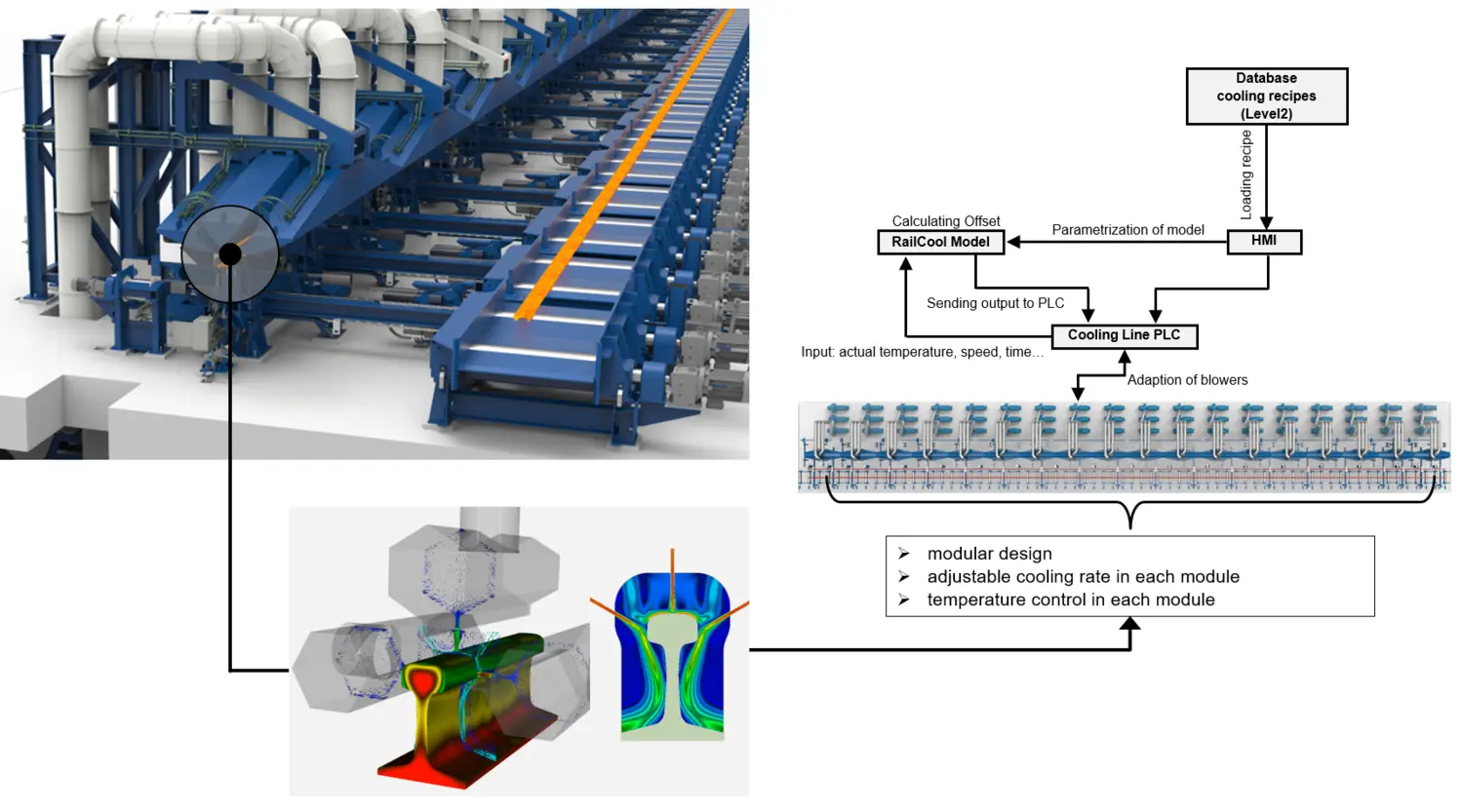
After the rolling process, the rail is transferred to the RailCool® area and moved into an upright position. Alignment devices ensure that the rail is precisely positioned during heat treatment, thus guaranteeing homogeneous and effective cooling. The RailCool® modules for heat-treating the rails use large quantities of air to achieve uniform cooling and eliminate any inconsistencies. An uneven temperature distribution along the rail length (like with the conventional rolling process) can be compensated by RailCool® modules that are individually set up and controlled. In each module, a selective cooling method is applied to homogenize the temperature in different areas of the rail head.
In addition, an integrated technological model is employed to automatically control the temperature of the rail during the process and to adjust the cooling rate based on the actual temperature measured. Consequently, the rail is heat-treated with the optimum cooling strategy. This dynamic adjustment of the cooling system according to the optimum temperature curve ensures that the relevant rail quality requirements are met for a variety of different steel grades, standards, and sizes. RailCool® offers full operational flexibility and allows cooling recipes to be easily adapted to meet specific production demands. This adaptability goes hand in hand with the system’s ability to guarantee consistent product quality.
Sustainable rail head hardening technology for new and existing facilities
In the rail production sector, the progress driven by the new RailCool® Air rail head hardening technology marks a significant step forward in terms of efficiency, durability, and sustainability. This innovative heat treatment process uses the heat from the hot rolling phase to improve the mechanical properties of the rails, without the need for expensive alloying elements.
By integrating this process into rail production operations, the rails deliver better performance and have longer service life. Another major advantage of this method is its environmental compatibility. RailCool® Air completely does away with water and chemical additives and instead relies on air-based cooling. The lack of water means that no water treatment system is required so there is no need to service clogged nozzles, thus minimizing operational interruptions, maintenance costs, and initial investment costs. During the hardening process with RailCool® technology, the air is accelerated by an electric motor-driven fan to achieve the desired flow rate. The electricity for this can be obtained from renewable energy sources. With this method, energy consumption can be effectively controlled in a sustainable way and the plant’s carbon footprint further reduced. By integrating RailCool® Air after the rolling process, there is no need for an induction heater, which means considerable CAPEX and OPEX savings. The heat from the rolling process is then used directly for hardening, thus minimizing the energy required and eliminating the need for additional heating systems.
RailCool® Air is not only suitable for new rail mills, but it can also be flexibly integrated into rolling mill facilities currently in operation. The compact design of the system reduces the space required for the layout, which is limited in existing works. Depending on the design, the installation can sometimes be carried out without having to halt production, thus largely reducing downtimes.