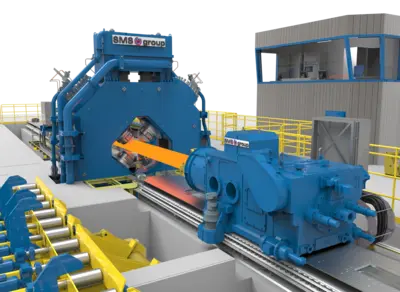
Through ongoing development of the SMX hydraulic radial forging machine and innovative process concepts, SMS group continuously extends the limits of performance and precision.
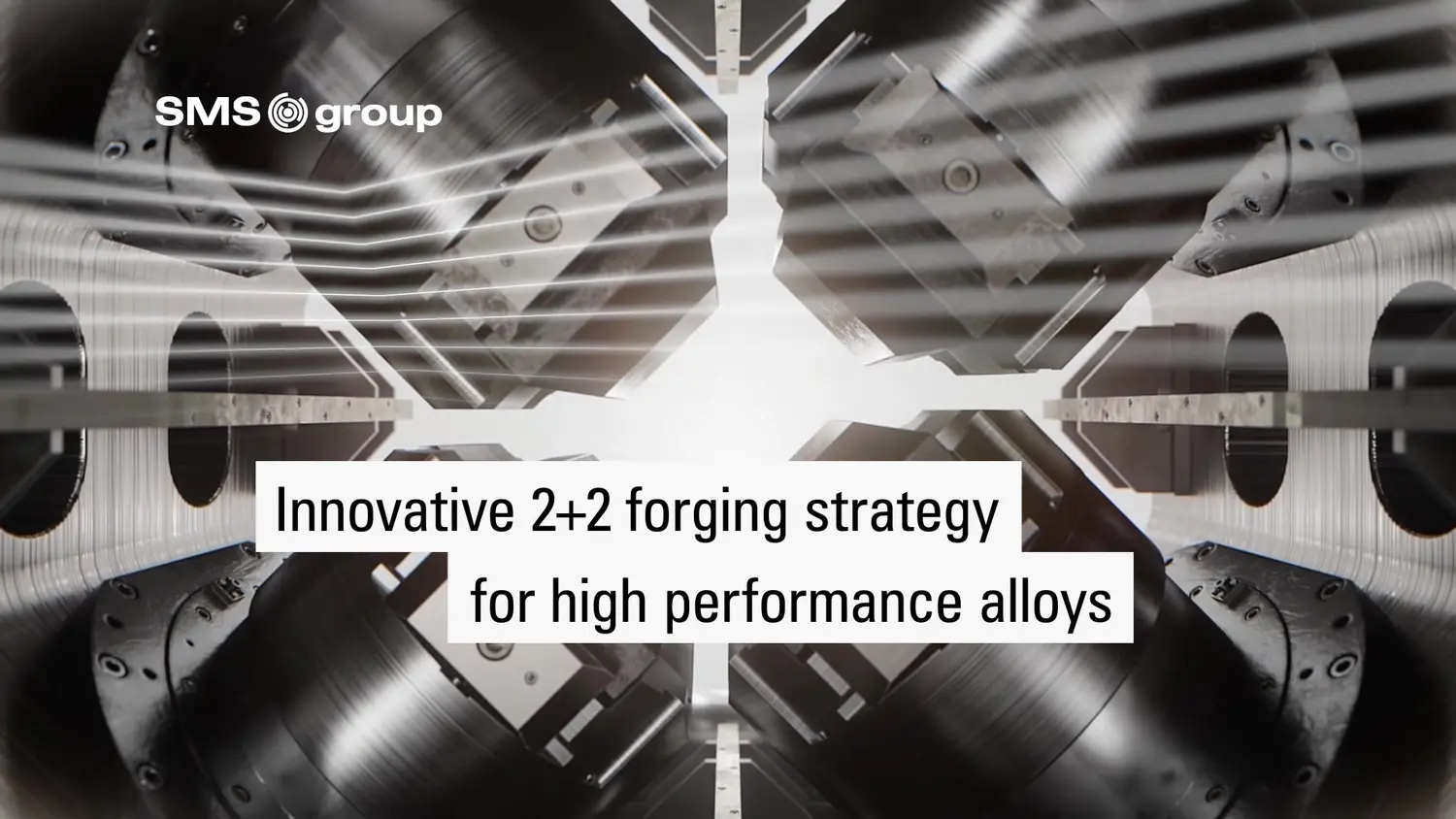
A recent breakthrough is the "2+2 forging" strategy, which represents a paradigm shift in radial forging. Unlike conventional methods, this strategy alternates the forging of tool pairs and combines the high productivity of radial forging with the optimal core penetration of open-die forging. The corresponding IP patent approval process is already underway.
The SMX hydraulic radial forging machine, when used together with the “2+2 forging” strategy, provides a technically distinct solution for achieving targeted core deformation and controlled microstructural refinement in high-performance alloys. In industries such as aerospace and medical, material integrity is crucial. Conventional radial and spiral forging methods can struggle to deliver a uniformly refined core to ensure enhanced material integrity or might require pre-forging. The SMX hydraulic radial forging machine combined with the “2+2 forging” strategy close this gap and meet the stringent demands of these industries.
The innovative "2+2 forging" strategy offers an efficient solution capable of supporting both greenfield and brownfield operators and is available as a software update to process demanding new alloys with superior core deformation and microstructural quality.
How does it work? – The technological innovation of the “2+2 forging” strategy
Modern materials such as nickel base superalloys, titanium and high strength steels impose strict demands on forming strategy and process control. Achieving a refined and uniform grain structure is required to ensure increased material quality. While conventional radial and spiral forging methods deliver good results regarding productivity and core deformation, the “2+2 forging” strategy can further optimize these outcomes.
Unlike conventional methods, this innovative approach alternates the actuation of two die pairs while the manipulator feeds in large increments (typically >100 mm). Executed with controlled feed and large tool penetration, this forging strategy leads to a significant better core penetration. Key advantages include:
Larger manipulator feed: With feed exceeding 100 mm, the SMX achieves greater material deformation per stroke, ensuring superior forging quality at shorter production time compared to the conventional forging strategy.
Improved bite ratio: The larger bite ratio facilitates deeper penetration of the forging tools into the material, enabling better control over deformation and reducing surface imperfections.
Enhanced core deformation: By optimizing the distribution of forces, the "2+2 forging" strategy achieves superior core deformation, ensuring a refined and uniform grain structure that is critical for high-performance applications.
This forging strategy is particularly suited to materials like Inconel 718, a superalloy widely used in aerospace and medical components due to its exceptional strength and resistance to extreme temperatures or Titanium.
Hydraulic precision meets “2+2 forging” strategy
SMX ensures constant core pressure for optimal product results
A hydraulic driven radial forging machine is a fundamental requirement for the “2+2 forging” strategy. Hydraulic systems deliver constant force over the entire stroke of the forging cylinders, which is necessary to maintain high pressure in the workpiece core and a stable deformation rate throughout each stroke.
The SMX hydraulic radial forging machine sets a new benchmark in forging technology and innovative engineering with robust performance metrics. Key specifications include:
Fully hydraulic drive: The SMX leverages a compact hydraulic design to deliver unparalleled efficiency and precision.
Forging force: With a maximum forging force of up to 25 MN, the SMX handles even the most demanding applications with ease.
Stroke rate: Achieving up to 225 strokes per minute, the machine ensures high productivity without compromising on quality.
Power availability: The hydraulic system provides full power at any ram position, enabling consistent performance throughout the forging cycle with a defined deformation rate.
This combination of features makes the SMX hydraulic radial forging machine not only highly efficient but also uniquely capable of implementing the "2+2 forging" strategy, which relies on precise control of forging forces and tool movement.
The “2+2 forging” strategy delivers higher material strength and fatigue resistance
The principal metallurgical advantage of the “2+2 forging” strategy is a consistently refined and homogeneous core microstructure. By shifting equivalent strain into the part interior, grains become finer and more uniform. Controlled high pressures and optimized deformation paths promote effective void closure and reduce internal defects. In practice, this results in higher yield strength, improved fatigue resistance and lower scrap rates, important for safety sensitive aerospace and medical components.
Benefits of the SMX with 2+2 forging strategy
- Improved core grain size: The intensified core deformation achieved by 2+2 forging produces smaller, more uniform grains and directly enhances mechanical properties.
- Hydraulic drive advantage: The hydraulic force control system provides the precision needed for smooth transitions between die pairs and consistent, reproducible deformation.
- High productivity: Compared with spiral and conventional radial forging, the SMX delivers higher productivity without compromising component quality or integrity.
- Exceptional strength, fatigue resistance and thermal stability: In the aerospace industry, turbine blades, structural elements and engine parts require exceptional strength, fatigue resistance and thermal stability. In medical applications, implants and surgical tools benefit from enhanced biocompatibility and material durability. Leveraging the SMX hydraulic radial forging machine together with the “2+2 forging” strategy, manufacturers can reliably produce high value components that meet the stringent requirements of aerospace and medical sectors, with improved reproducibility and tighter process control.