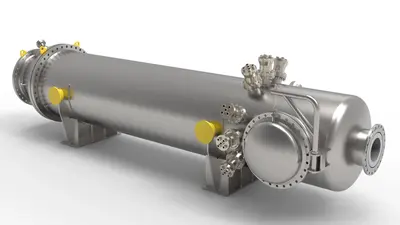
As industries accelerate the transition to lower-carbon operations, practical electrification of high-temperature processes becomes a central lever to reduce CO₂ emissions while preserving productivity. Paul Wurth Tempra, developed by SMS group, is a continuous flow electric gas heater engineered to meet this need: a tailored solution that converts electrical energy into precisely controlled, high-temperature gas streams suitable for demanding metallurgical and industrial applications.
Innovation rooted in Paul Wurth Blast Furnace expertise
Tempra was conceived from the beginning as a form of reliable innovation—one that translates long-standing expertise in hot blast stoves refractory system into a new energy context. Tempra’s design is thus born from the union of two proven technologies: holed refractory checkers bricks — time-tested components from hot blast stove practice — and resistive heating elements inserted directly into the checker channels. Electrical power is converted into heat by the Joule effect within the channel geometry, promoting direct and efficient heat transfer to the gas flow. The checker bricks deliver both mechanical integrity and electrical insulation, resulting in a repeatable, modular geometry that readily scales to multi-megawatt capacity while maintaining a compact footprint. The result is not a completely new heating principle, but a continuous-flow electric heating solution from established refractory‑based concepts.
Prototype story and technical proof points
Development progressed from theoretical concept to a validated prototype built at full internal geometry. The 0.5 MW prototype operated reliably at elevated temperatures and demonstrated robust temperature response to flowrate changes, confirming its suitability for controlled industrial operation. Measured key figures include a rated power of 0.5 MW at 690 V phase-to-phase and sustained gas outlet temperatures up to 1080 °C. Prototype efficiency at nominal power exceeded 95%. These data substantiate Tempra’s potential for scale-up and its capability to replace fossil-fuels based heating systems where low-carbon electricity is available.
How Tempra improves process performance
Because heating occurs directly within a structured checker matrix, Tempra delivers tight thermal control of feed gases, enabling stable process conditions and stable recovery after disturbances. The thermal inertia of the system prevents peaks in the thermal load distribution, which is especially valuable in terms of predictable behavior, materials integrity and operational confidence - critical attributes for metallurgical operations pursuing both performance and decarbonization.
Applications across high-temperature workflows
Tempra is applicable where reliable, high-temperature gas heating is essential: direct reduction processes including shaft furnaces and fluidized beds, syngas conditioning for blast furnace or tuyere injection, and feed-gas heating in sustainable aviation fuel production complexes.
Development status and next steps
Laboratory validation — covering heating elements and refractories (i.e. oxidation resistance, metal dusting and behavior in hydrogen atmosphere) — has been completed along with electrical and automation trials and analytical validation using Computational Fluid Dynamics (CFD), Finite Element Method (FEM) and electromagnetic simulation. The technology currently stands at TRL (Technology Readiness Level) 6 with more than 1,000 hours of cumulative operation. European certification activities for PED (Pressure Equipment Directive) and ATEX (Explosive Atmospheres Directive) have been completed on the prototype with Notified Body as part of the pathway to TRL 8.
Paul Wurth Tempra represents a pragmatic, technically coherent route to electrified gas heating, combining Paul Wurth hot blast stove refractory know-how with electrical heating elements to deliver high-temperature performance, exceptional efficiency and tailor-made solutions. For companies exploring electrification as a means to reduce emissions while maintaining production integrity, Tempra offers a validated stepping stone toward greener, more resilient industrial heat.