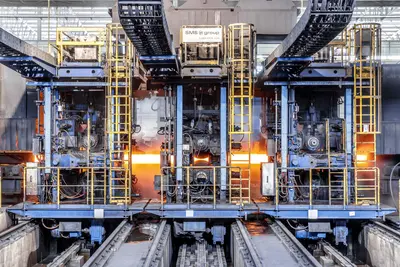
Global demand for hot-rolled steel sections is steadily growing, driven by urbanization and the development of new districts and high-rise projects, the expansion of transport infrastructure, and the construction of industrial complexes. At the same time, customers’ requirements in terms of quantities, cross-sections, and product quality are increasing. However, outdated core equipment in many section mills is proving to be an obstacle to higher productivity, making it more difficult to implement quality improvements in a cost-effective way or to introduce new formats to expand the product portfolio. As a systems supplier, SMS group offers targeted modernization solutions for these core equipment with its latest generation of CCS® (compact cartridge stand) and CRS® (compact roller straightener) technologies.
The revamp concepts are designed in such a way that they can often be implemented during regular annual outages with short shutdown periods. This allows them to be precisely tailored to the customer’s specific needs. The focus of the upgrade is on rapid implementation, high plant availability, and measurable enhancements in productivity and product quality. Through these targeted measures, SMS strengthens the competitiveness of plant owners and enables a rapid return on investment.
CCS®: Future-proof mill stand technology
The latest-generation CCS® replaces conventional and older stand variants. It features highly rigid, compact mill housings with fully hydraulic roll-gap adjustment. This stand is where the quality-defining features of the final product in terms of shape, productivity, and quality are produced. The stands are operated in reversing mode in a tandem-stand arrangement. The technology is suitable for heavy section mills, medium section mills, and rail mills.
Thanks to the variable housing distance, the CCS® can be adapted to the relevant rolling concept. This means they can be used in a universal or two high configuration. Existing rolls and guides can often be reused with the new stands. This reduces investment costs. A key feature is the quick change of rolls and guides as a pre-assembled unit. The changeover is prepared offline and then takes place fully automatically in less than 20 minutes.
In modernization projects, mill stands can usually be upgraded to the latest CCS® technology without the need to carry out any major foundation work and/or replace the drive train.
Process control is handled by the technological control system with automatic roll gap control, automatic calibration, and precise adaptation to rolling parameter changes, including mill spring compensation and dynamic control under load. The result is greater process stability and lower operating costs.
The advantages of an upgrade are immediately visible: shorter product changeover times, improved surface quality, and products that can be reproduced within the closest tolerance range.
CRS®: Automated precision
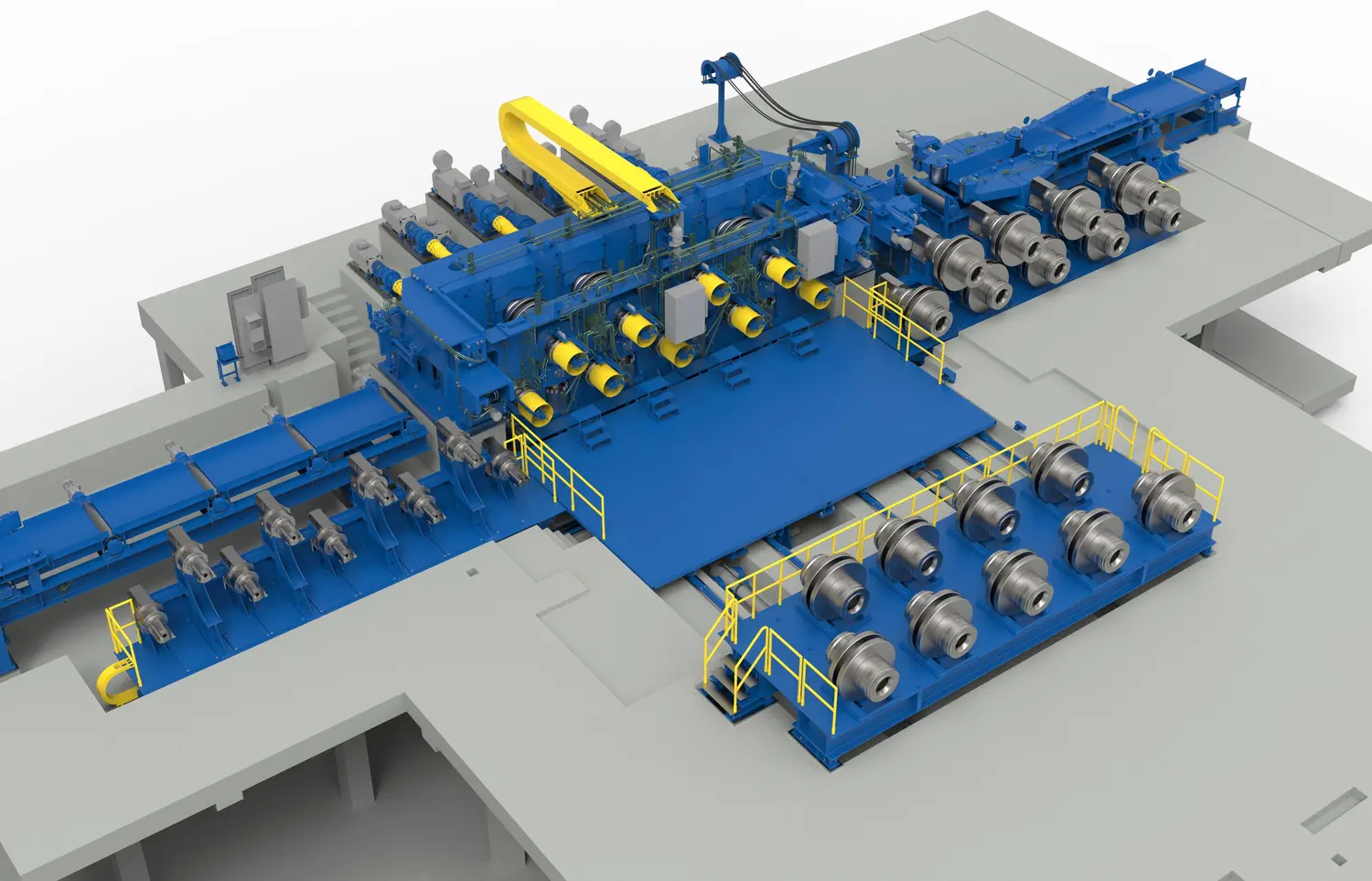
CRS® technology was specially designed for the straightening process for sections. It is a key component when a product range is to be extended to include larger cross-sections and/or productivity is to be enhanced as part of an upgrade. It is a modular solution that can be integrated into existing section mills without any great effort. It is also suitable for the targeted expansion of existing line capacities.
The CRS® system is characterized by nine individually driven straightening shafts with chocks on both sides and hydraulic adjustment system. Automatic load sharing control during the straightening process ensures consistent results with no manual interventions required.
Straightening roll changes on conventional straighteners are particularly time-consuming, which has a negative impact on a section mill’s overall efficiency. This is where CRS® offers an automated solution: The complete set of straightening rolls can be changed on both sides within minutes using changing cars. This reduces product changeover times, cuts personnel costs, and improves plant availability. This makes CRS® an effective building block for upgrades aimed at expanding the market and advancing quality standards. A targeted modernization by SMS, tailored to the customer’s requirements, strengthens a customer’s competitiveness and increases productivity, resulting in a rapid return on investment in the project.
Enhanced performance with CCS® and CRS® upgrades
- Heavy section mill at Gerdau Ameristeel (Petersburg, USA): During several short shutdowns, two new CCS® were integrated as the two-high mill stands. The main shutdown period was just two weeks; the result in terms of throughput and product quality was immediately visible.
- Heavy section mill at Nucor-Yamato Steel (Blytheville, USA): A new tandem stand arrangement consisting of three CCS® was integrated into the hot rolling line, for which two existing stand positions were removed. The old conventional plant configuration was thus transformed into a modern tandem reversing mill. Higher rolling forces and rolling torques, hydraulic underload adjustment, faster product program changes, and the use of larger roll diameters resulted in a wider product portfolio, higher yield, and higher plant availability. This was implemented during a few short intermediate shutdowns, followed by a 16 day main shutdown.
- Heavy section mill at Hyundai Steel (Incheon, South Korea): To produce larger product dimensions, the existing hot rolling line was revamped and equipped with a new CCS® tandem stand group and an additional CCS® finishing stand. The outcome is better tolerances, higher rolling speeds, and noticeably lower maintenance expenditure.
- Medium section mill at CELSA (Barcelona, Spain): By modernizing the existing CRS® straightener and replacing the cooling bed, CELSA was able to expand its product portfolio and increase its production capacity 1 million t/year. HEA/HEB wide-flanged beams with a section height of up to 600 mm can now also be produced. This additional market potential was realized during planned maintenance shutdowns.
