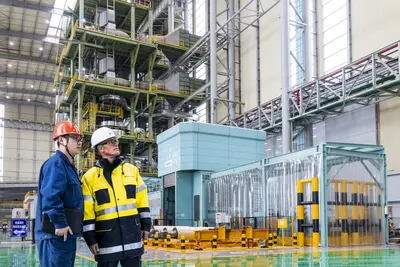
Overcapacity, trade rules, volatile energy prices, and decarbonization demands push the European steel industry to cut costs, improve performance, enhance quality, and make smarter investments. Untapped efficiency reserves must be identified and addressed. Plant technology, production, organization, and operational know-how must always be considered holistically. Against this backdrop, structured analysis with a holistic view of production processes is gaining importance.
Technology consulting: Three central fields of action
SMS group pursues an integrated and holistic consulting approach with a customer-specific focus when optimizing existing plants. This approach unites three central fields: technological foundation, operational excellence, and human resources “capability” and management. These pillars consistently align all operational processes, resources, and employees toward the sustainable maximization of production, customer value, quality, efficiency, as well as cost and time efficiency.
The goal is stable, predictable, and sustainably improved performance along the entire value chain. To achieve this, SMS group combines traditional technology consulting with operational excellence methods. One tool is the determination of relevant KPIs through detailed statistical data analysis to identify critical processes and bottlenecks.
Equally important as the technological foundation are the qualification and motivation of personnel. The willingness for continuous improvement at all work levels is crucial for achieving defined goals.
The implementation of technology consulting takes place during ongoing operations and actively involves teams at all work levels, so that “quick wins” can be realized immediately.
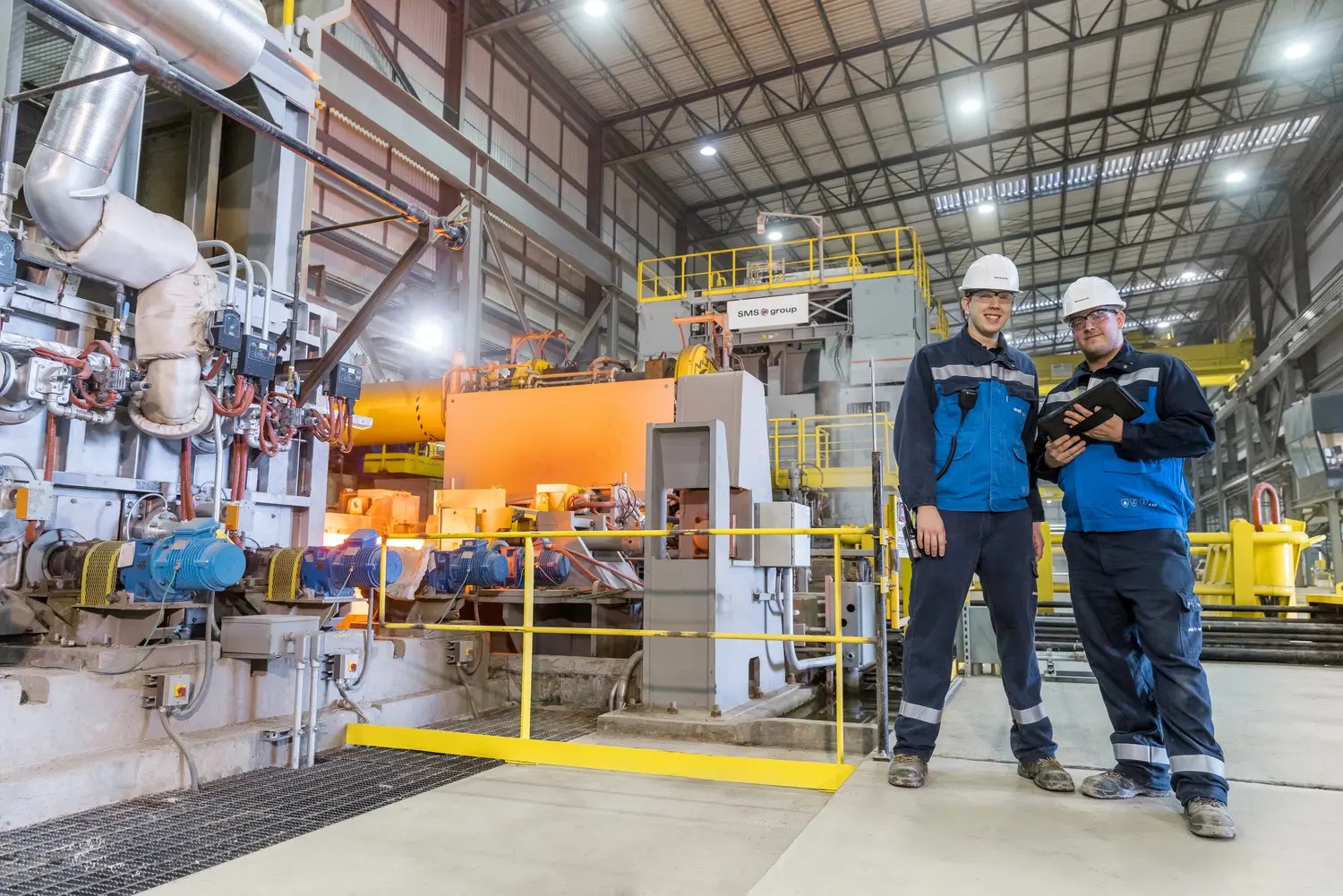
Industry-specific methodology
Transferring proven methods from the automotive or semiconductor industries encounters specific limits in the steel sector. Discontinuous process flows, limited data availability of older plants, and the high physical and metallurgical complexity make the direct application of standardized models difficult.
When applied correctly, methods such as DMAIC (Define, Measure, Act, Improve, Control), RCA (Root Cause Analysis), and PDCA (Plan, Do, Control, Act), as well as statistical tools from Six Sigma, can, in combination with the technical, operational, and process knowledge of SMS experts, provide a powerful solution.
This allows efficiency improvement potentials to be quantified, cause-effect relationships to be systematically examined, and improvement measures to be prioritized. Crucial here is the integration of the methodology, taking into account plant structure, media management, logistics of material and auxiliary flows, control technology, and available personnel resources.
Practical example: Steel plant analysis with logistics model as digital twin
In current projects, SMS group analyzed the entire value chain of integrated steel plants from hot metal desulfurization to the continuous casting plant. Process data is collected at high resolution, and relevant key figures such as cycle time, output, and their statistical deviations are determined and compared with design values. The hypotheses derived from the analysis are then verified through walkthroughs and discussions with customer-side specialists.
In parallel, logistics and material flow models are built as a digital twin of the plant, which, in addition to the main technical processes, also map transport movements, ladle transports, and non-value-adding secondary processes. In this way, potential bottlenecks at increasing utilization can be identified early. Various production scenarios are simulated and solution scenarios tested, allowing the most promising countermeasures to be identified, tested, and implemented.
In a recent customer project, for example, secondary processes such as ladle slagging after the casting process and ladle preparation and maintenance were identified as weak points. Relocating certain secondary processes to another hall area and reassigning specific tasks to a less utilized crane prevented bottlenecks at higher utilization, as identified in the simulation.
Finally, a roadmap is developed that prioritizes short-, medium-, and long-term measures. These are evaluated based on economic efficiency, feasibility, and implementation timeframe. In addition to classic OPEX approaches, as described above, structural adjustments in production logistics and personnel-related aspects (e.g., operational responsibilities, qualification profiles) are also considered, and a training program for employees is proposed.
Conclusion
SMS group offers a technologically integrated, holistic consulting approach (technology, process, quality, and operational excellence) specifically aimed at performance and quality improvement in existing plants.
Through needs-based data collection and the application of statistical analyses and methods, customer- and project-specific quick wins are first identified and realized. The main goal is long-term and sustainable performance and quality improvements with minimal CAPEX.
The combination of operational excellence with consulting methodological expertise, considering an experienced team, is the key to success and satisfied customers. The results are better performance, higher productivity with reduced downtime, lower variance, and stronger operational resilience.
The logistics model ensures that bottlenecks are identified early, before they can negatively impact the entire production chain, and that appropriate solutions are identified, tested, and implemented.
Ultimately, strengthening operational resilience lays the foundation for successful transformation. This not only meets current industrial challenges but also strategically positions companies for future market conditions.