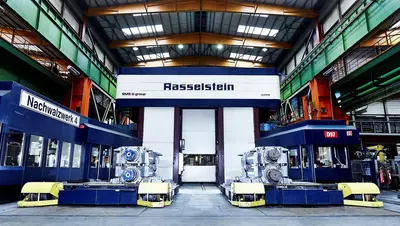
In Europe and the USA, numerous older, yet highly competitive, cold rolling mills are operated. To make the operation of cold rolling mills future-proof, SMS group offers its customers tailor-made technological solutions. Many cold rolling mills are designed as 4-high mills with a relatively big work roll diameter which limits the reduction capability of the mill. A change to a smaller work roll diameter for one of the work rolls (asymmetric rolling) increases these capabilities. It is precisely here that the asymmetric rolling concept offers a solution to increase the reduction capability.
Asymmetrical rolling
What is asymmetrical rolling at all? The starting point is a 4-high stand design. The solution is to convert a 4-high stand into a 5-high stand (Quinto) with different work roll diameter for the upper and lower work roll. The difference in the work roll diameter - the so-called asymmetry or asymmetric rolling – can be considered virtually as an averaged work rolling diameter. This may seem surprising or unusual at first glance. In fact, SMS group has implemented and tested such a technical solution with great success at a renowned German customer. The operating results were so convincing that this solution can be used as a blueprint beyond the individual solution or at least as an inspiring reference example.
How to convert a 4-high into a Quinto
The technical solution is as ingenious as it is simple. In the mill stand, the top work roll is replaced by a cartridge with two thinner rolls. The existing top work roll of the 4-high is replaced by a complete cartridge containing a roll assembly mainly consisting of intermediate roll and work roll. The change is simple and takes place in the scope of a regular work roll change. It is just as easy to replace the cartridge with the original work roll. This will considerably increase the flexibility of the rolling mill.


Benefits of the asymmetric rolling
Generally, it can be stated that rolling in 4-high mode requires a higher rolling force than rolling in 5-high mode. Regarding the operating costs, this is a variable that cannot be neglected. Furthermore, in the Quinto mode clearly higher reductions per reduction pass can be achieved, as can be seen from the figure. Another essential finding that can be gained from the operating results of the pilot installation is that the range of rollable grades can be considerably extended. This is considerably increasing the possibility of using the existing plant and, at the same time is cutting operational costs.
Reference case Rasselstein
At the beginning of the 2020s, SMS group expanded the possibilities of the double cold reduction (DCR) mill at thyssenkrupp Rasselstein GmbH, a leading manufacturer of tinplate. In the production of tinplate for packaging products, pickled hot strip first passes the tandem DCR mill where the strip thickness is reduced for the first time. The cold strip is then guided through a continuous annealing line. The next step is rolling again in the Double Cold Reduction mill. Here the strip is either skin-passed or subjected to a further thickness reduction. This is why it is called “double cold reduction”.
The goal of thyssenkrupp Rasselstein GmbH was to increase the thickness reduction in the first mill stand of the DCR mill by up to 50 percent. The minimum strip thickness to be achieved should be 0.1 mm.
After the implementation of the assymetric rolling concept, thyssenkrupp Rasselstein GmbH was was impressed by the results of the rolling tests with the roll cassette. It was found that not only new grades could be successfully rolled, but also more materials could be rolled at a higher rolling speed. In the 5-roll mode, it was possible to roll a wider range of materials at a lower roll force and/or higher thickness reduction or lower line loads.

