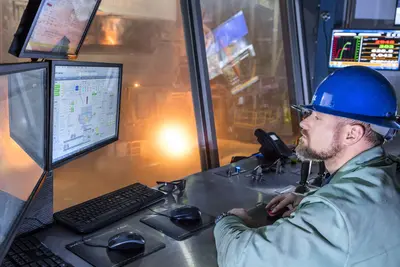
The landscape for level 2 systems in steelmaking and casting is continuously evolving. Today's demands surpass traditional needs for process operation visualization, process tracking and reporting. To keep up with these developments and in order to remain competitive companies must focus on utilizing their production capacities efficiently while reducing throughput times. Heats and slabs must be produced with ever-greater precision and quality – and demands on aspects such as quality assurance, minimal downtimes to enhance production efficiency, and rapid system adaptation to new production requirements and function extension are growing significantly.
Additionally, software services and according, operational support are becoming increasingly vital, since steel producers aim to continuously optimize level 2 systems and software systems long after their initial implementation. A good example are performance-based service contracts, where functionality enhancements are assessed based on their measurable contribution to improve production outcomes.
SMS group’s level 2 X-Pact® Process Guidance Platform, a software solution for process automation, establishes the critical foundation. Combined with SMS group’s unique Digital Ready Standard, it provides the essential prerequisites for enabling the learning steel plant. With our digital ready standard, all automation data is described homogenously using contextual information (metadata) and data access information and published in a standardized way via the supported interface technologies. Individual, independently operating software modules communicate via ProconTEL event bus and are supplied with process data from a central process data lake called Information Hub. State-of-the-art frameworks, .NET programming languages, and Web-HMI user interface are implemented, ensuring that these remain the modern standard for years to come. Data is structured and stored according to the same rules thanks to the digital ready standard.
Using AI as a powerful booster
Building on this solid foundation, the integration of artificial intelligence (AI) becomes remarkably powerful. The harmonized, modular architecture and standardized data storage provided by the level 2 Process Guidance Platform act as an essential enabler for deploying AI-driven functional modules. By leveraging structured and consistent datasets alongside modern communication frameworks, AI can seamlessly analyze critical processes and optimize operations in real-time.
AI modules can, for example, analyze and optimize software input parameters. By continuously evaluating operating data and comparing it with software functions, AI can dynamically optimize critical parameters, thus ensuring optimal performance under varying production conditions. This is applied, for example, in the commissioning of metallurgical models to determine empirically determined parameters more quickly and accurately. This is very helpful because the models are highly complex, which makes conventional linear optimization approaches very time-consuming and does not always lead to satisfying results.
This approach enhances the precision and reliability of process models, leading to more efficient resource utilization and reduced deviations in production quality.
Such AI-driven tuning stabilizes critical functionalities and empowers companies to achieve higher consistency and control over production outcomes. With the robust infrastructure of the level 2 Process Guidance Platform, the application of AI has the potential to be a game-changer, driving productivity, improving the accuracy of process models, and ensuring competitiveness in a demanding industry.
How AI optimizes existing metallurgical models by enhancing their accuracy, adaptability, and efficiency
Metallurgical models provide a mathematical description of processes and operations. In the context of a steel plant, these models describe, for example, the processes occurring in a basic oxygen furnace (BOF) or argon oxygen cecarburization (AOD). They are used to calculate an optimal and realistic process flow based on predefined process targets and specifications, such as target temperature, chemical composition, or input materials, ultimately aiming to meet these specifications as accurately as possible. The requirements for a model can therefore be distilled into two main characteristics.
- First characteristic: the model should describe reality and thus the process as accurately as possible.
- Second characteristic: the model should be capable of optimally implementing external requirements – meaning high accuracy, minimal resource usage, in the shortest possible time, etc.
But how can the precision of the model be increased? One approach is to represent the underlying process more accurately by considering more influencing factors, as well as the interconnections and dependencies between sub processes within the model. The more information that is taken into account, the more complex the description of the entire process becomes. A direct and inevitable consequence is that the associated model description also becomes significantly more complex, which can be reflected, for example, in a greater number of parameters or nonlinear relationships. As the number of input parameters increases, the effort required to find the right set of parameters to meet the second requirement increases exponentially. Similarly, the number of special cases to be considered also rises, which can be counterproductive to the first requirement regarding the precision of the model. To effectively resolve this conflict, AI can be utilized. It can be used to optimize existing metallurgical models by enhancing their accuracy, adaptability, and efficiency.
Applications:
- Improved process accuracy: AI, particularly machine learning algorithms, can analyze large datasets from historical process operations, such as temperature profiles, chemical compositions, and material inputs. By identifying patterns and correlations, AI can refine the parameters of metallurgical models, making them better aligned with real-world outcomes.
- Dynamic parameter tuning: traditional models often rely on static assumptions or manual adjustments. AI can dynamically adjust process parameters, such as target temperatures or chemical inputs, in real-time based on changing conditions, ensuring the model remains optimal under varying scenarios.
- Resource optimization: AI can minimize resource consumption by identifying the most efficient process paths. For instance, it can predict the exact amount of alloying elements or energy required to achieve the desired steel composition, reducing waste and costs.
- Anomaly detection and prediction: AI can detect deviations or anomalies in the process, such as unexpected slag formation or temperature fluctuations, and recommend corrective actions. This predictive capability enhances the reliability of the model and prevents costly errors.
- Faster simulations: With AI, metallurgical models can process complex calculations faster, enabling quicker decision-making. This is particularly useful for real-time applications, such as adjusting furnace operations during production.