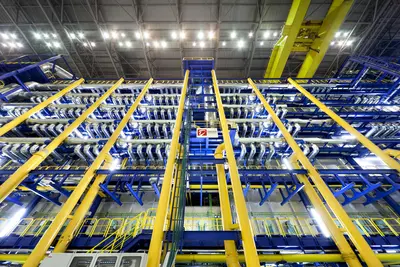
The production of modern AHSS increasingly depends on the ability to stabilize material properties in annealing and galvanizing lines despite fluctuating upstream conditions. Automotive manufacturers require consistent strength and formability, not only over the entire length of the coils, but also from coil to coil. Achieving this level of reproducibility demands more than precise temperature control. It requires direct insight into the evolving microstructure during annealing, where the mechanical properties of AHSS are ultimately defined. Because critical phase transformations occur inside the furnace, deviations detected only at the line exit are irreversible. As a result, modern strategies focus on real‑time microstructure information combined with intelligent furnace control to stabilize the transformation process as it occurs.
Integrated control of thermal profiles and microstructure
The intelligent furnace concept integrates predictive models, microstructure analytics and in‑line measurement to form a holistic system capable of anticipating process drift and compensating for variable upstream conditions. It brings together a high‑precision mathematical furnace model, online strength monitoring, a microstructure prediction model, a data‑driven optimization framework, and X‑ray diffraction‑based phase measurement directly inside the annealing furnace. This synergy enables the furnace to adjust thermally relevant parameters proactively rather than reacting after deviations occur.
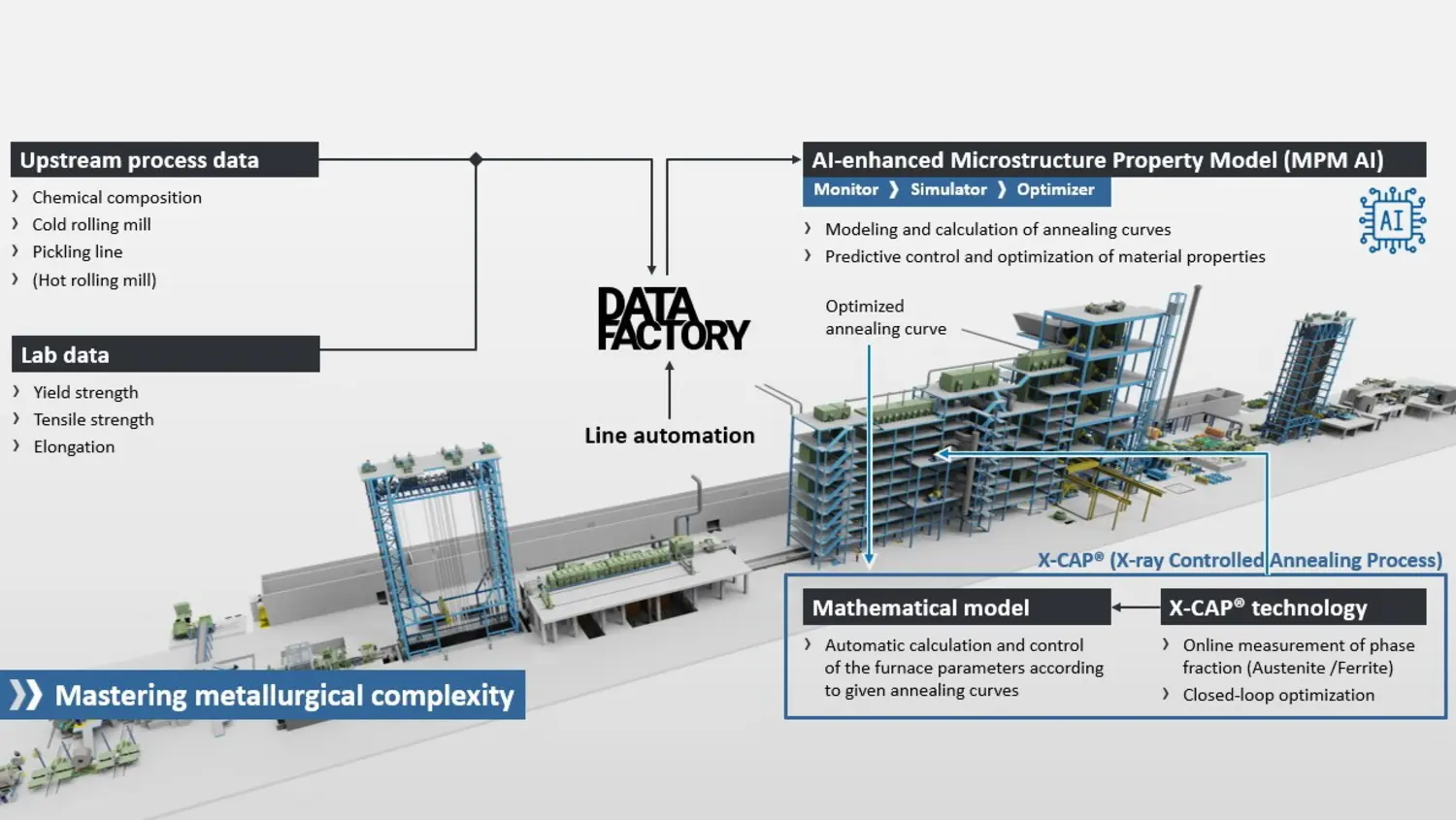
At the core of mechanical property formation in AHSS is the fraction of austenite before rapid cooling. This secondary phase formation is responsible for the strength level of dual‑phase and other multiphase steels, and even small deviations significantly affect final material behavior. A model‑only approach can predict this transformation, but only direct in‑furnace measurement captures real variations caused by coil chemistry, rolling history, temperature recovery, or furnace atmosphere.
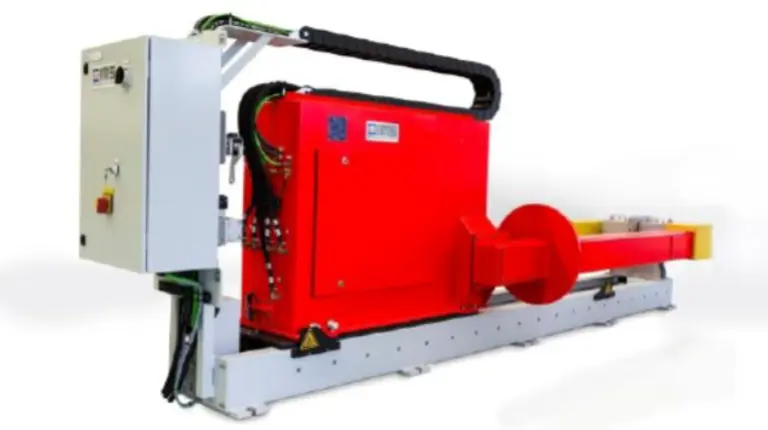
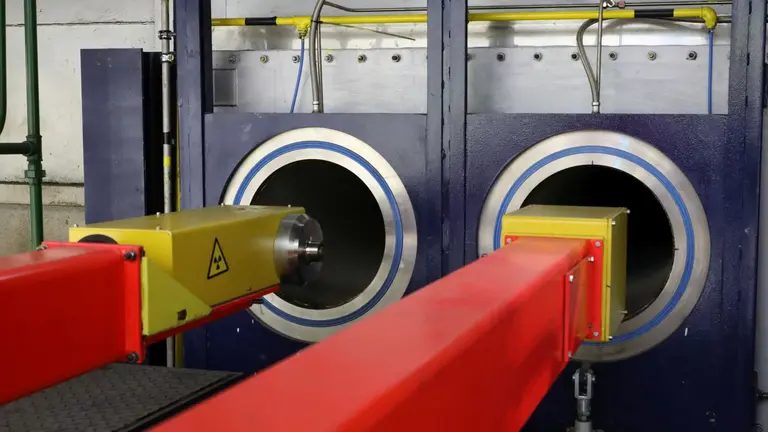
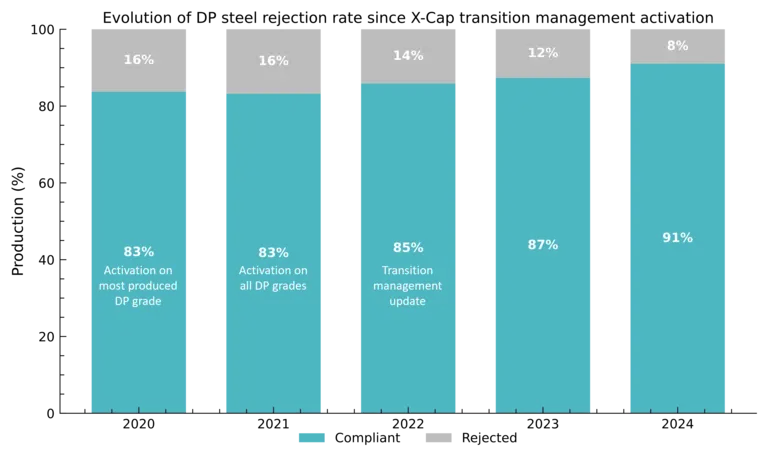
X‑ray diffraction applied directly within the heating zone makes the current phase fraction visible in real time. Through the X‑CAP® (X‑ray Controlled Annealing Process) technology, the furnace can regulate its parameters precisely during the stage in which the microstructure is still adjustable, enabling true closed‑loop control of the annealing process.
Predictive furnace modeling for stable thermal behavior
The furnace mathematical model complements real‑time phase measurement by calculating optimal temperature profiles, atmosphere settings and line speed based on thermodynamic behavior. It uses real‑time physics‑based predictions to stabilize furnace reactions, minimize temperature overshoot and eliminate inconsistencies related to manual adjustments. Transition management between grades and thicknesses becomes smoother because the model anticipates how the furnace will respond, selecting optimized routes that maintain metallurgical limits even during challenging AHSS changeovers. As a result, stable heat cycles are reached faster, material waste decreases and dependency on operator experience is reduced.
When phase measurement, predictive modeling and real‑time optimization act together, the furnace becomes capable of truly closed‑loop microstructure control. The measured austenite fraction feeds directly into the furnace model, which adjusts heating parameters before the transformation path diverges from the target. This ensures that the secondary phase formation during cooling aligns with the desired mechanical properties, stabilizing strip quality even under varying material conditions.
Data driven process integration for long-term stability
To enhance production stability further, online magnetic strength measurement (EMG IMPOC) monitors tensile and yield strength continuously after annealing. This closes the control loop by confirming the final mechanical properties for every coil and providing data for microstructure model refinement. The AI-enhanced X-Pact® Microstructure Property Model (MPM-AI) combining metallurgical models with machine learning tools itself links the annealing path to expected material behavior and supports both online control and offline development of new steel grades. Combined with production and laboratory data, it enables predictive analysis of process outcomes and identification of optimal heat treatment curves for upcoming coil schedules. The proven expertise that SMS group has built up in hot rolling with regard to microstructure property modeling plays a key role in the application of the model for continuous annealing.
All components converge in a data‑driven environment. With SMS DataFactory, upstream process information, laboratory results and in‑line measurements are consolidated and structured, creating a robust foundation for analysis, model training and long‑term optimization. This transparency ensures that each coil enters the furnace with a complete digital history, enabling the system to compensate for incoming variations before they influence the heat treatment outcome.
As these tools interact, they create an annealing process that is no longer driven solely by operator adjustments or fixed setpoints, but by continuous analysis of microstructure formation and furnace behavior. Real‑time austenite measurement stabilizes the secondary phase transformation. Predictive furnace control ensures uniform thermal treatment across grades and geometries. Online strength monitoring verifies final product performance. The microstructure model links process conditions to material response, while the data platform integrates all information for sustainable improvement. The result is a deeply interconnected system capable of delivering repeatable coil‑to‑coil quality, reducing scrap and increasing usable output on continuous annealing and galvanizing lines.
This integrated approach demonstrates how complex metallurgical processes can be mastered through the combination of physical modeling, microstructure science, and real‑time measurement. By observing the steel structure exactly where its properties are shaped, manufacturers gain the ability to guide the transformation with precision rather than reacting to deviations after the fact. For producers of advanced high‑strength steels, such capabilities form the basis for long‑term stability, higher yield and the confidence to meet increasingly demanding application requirements.