Choose a different country or region to see content for your location
Light theme
Light theme
Hint
Confirm
Magazine10 Min

A real success story: The world’s first CSP® Nexus plant

Steel Dynamics Inc. (SDI) has taken its next step toward the future of hot strip production with the commissioning of the world’s first CSP® Nexus line at its Sinton site in ­Texas, USA. As a long-standing operator of the CSP® process, SDI chose SMS group’s successor concept and implemented it as the first global reference in a comprehensive new manufacturing complex.

The new SDI Sinton complex is among the most advanced and comprehensive steel plant projects in North America. SMS group supplied the full scope for primary and secondary metallurgy as well as for hot and cold strip processing. The entire complex boasts an annual liquid‑steel capacity of over 3 million t. All components were integrated into the X-Pact® automation ecosystem, featuring a modular software architecture that interlinks all plant areas.

CSP® Nexus is the technological evolution of SMS group’s proven CSP® (compact strip production) platform with one crucial distinction: the complete decoupling of the continuous casting, roughing, and finishing mills. This real batch architecture provides, for the first time, control of all rolling phases with the flexibility and precision of conventional hot strip mills, while delivering a significantly more compact footprint and materially reduced energy consumption.

Technologically, the CSP® Nexus plant at SDI is far more than a compact combination of caster, rolling mill, and furnaces. It is designed as a fully decoupled, fully digitally controlled direct rolling process and, as such, opens up functional possibilities that until now were reserved for conventional hot strip mills. Each section of the plant is designed to precisely control temperature, time, and reduction profiles, aimed at producing a wide range of products at maximum energy efficiency and process stability levels.
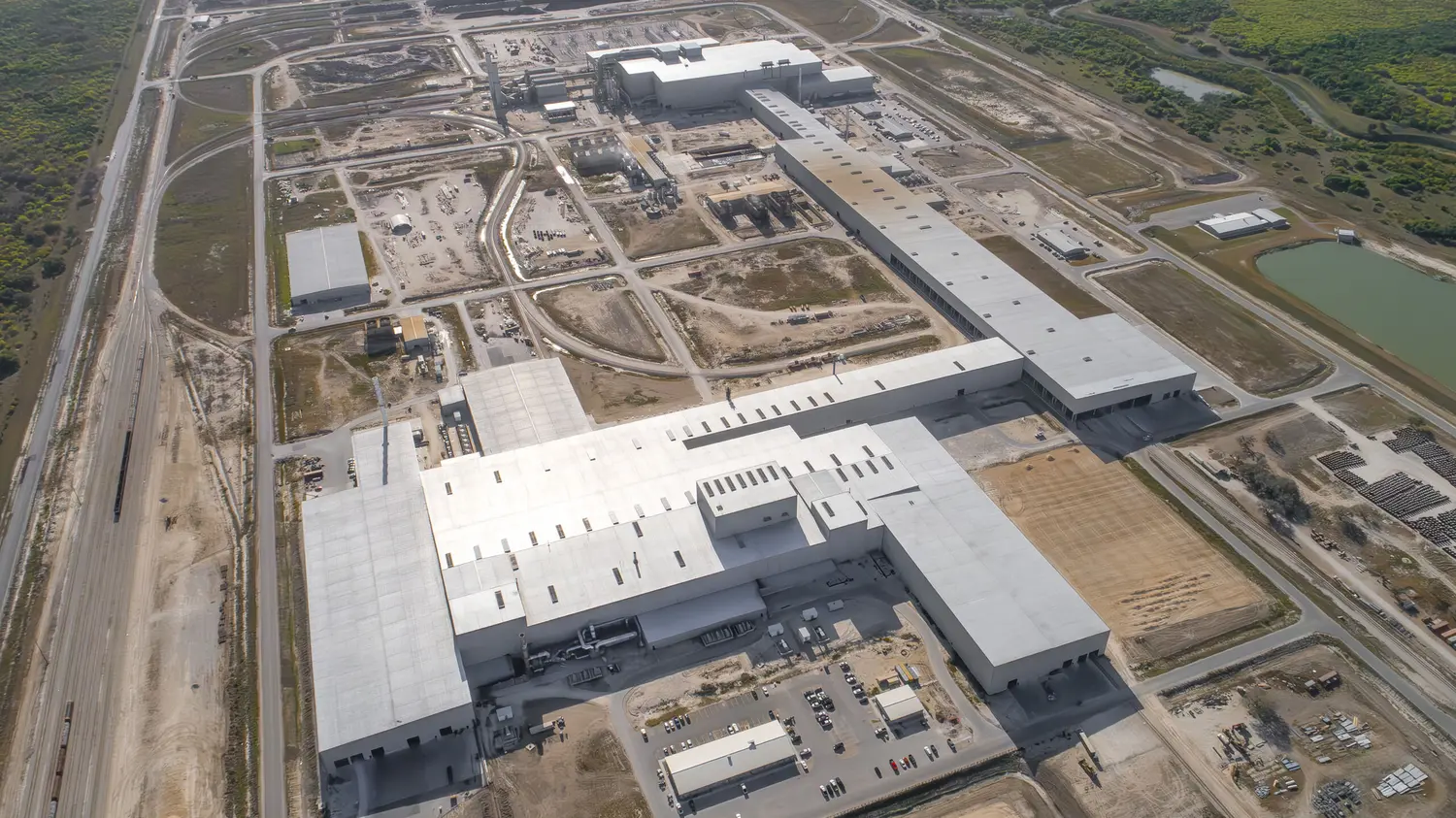
The SDI site in Sinton, Texas with meltshop, CSP Nexus plant, PL/TCM and strip processing complex

Continuous casting with high throughput and optimum control

The process starts with a single-strand curved caster based on a vertical bending concept with liquid core reduction (LCR plus). The strand thickness ranges between 110 and 140 mm – much thicker than in conventional CSP® plants of 50 to 90 mm. The strand is cast at up to 6 m/min.

By contrast with other thin slab casting and rolling (TSCR) concepts, in which casting and rolling are necessarily linked, the process at CSP® Nexus is decoupled immediately after casting. A pendulum shear cuts the strand to the precise coil weight, then the material flow is buffered and purposefully transferred.

This transfer to the first furnace takes place at a high temperature level: The casting process itself has temperatures of around 1,150 °C, so no energy-intensive heating is required. The role of the first furnace consists rather in the temperature homogenization of the cross-section and in thermal fine-tuning for the subsequent roughing process. This furnace also allows the buffering of slabs during a work roll change without interrupting the casting process and provides the logistics to add a second strand to increase productivity.

X‑Pact® Dynamic Furnace Control, integrated into the CSP® line’s level 2 automation structure, precisely calculates set points for the furnace zone temperature to heat up the slab to the given discharge temperature at the appropriate heating time, acceleration point, and buffer time. The system supports heating and acceleration strategies to reduce energy consumption by lowering furnace zone set points where feasible and/or to increase buffer times by initiating slab acceleration as early as possible, all fully aligned with higher‑level control and planning functions.
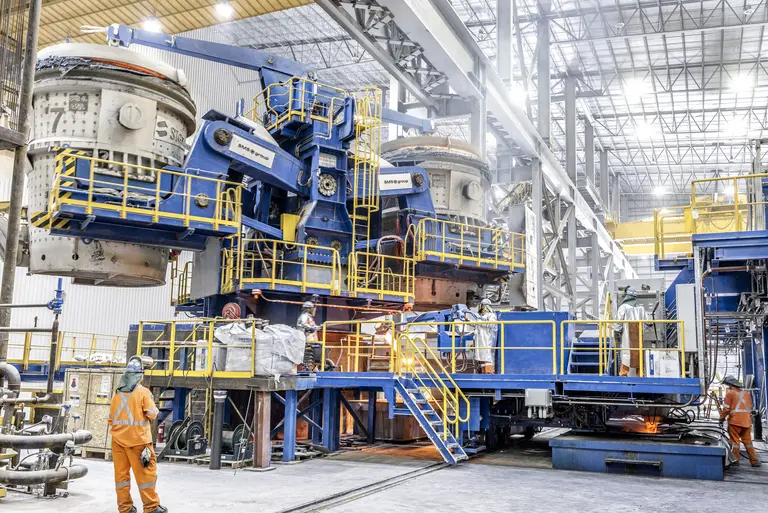
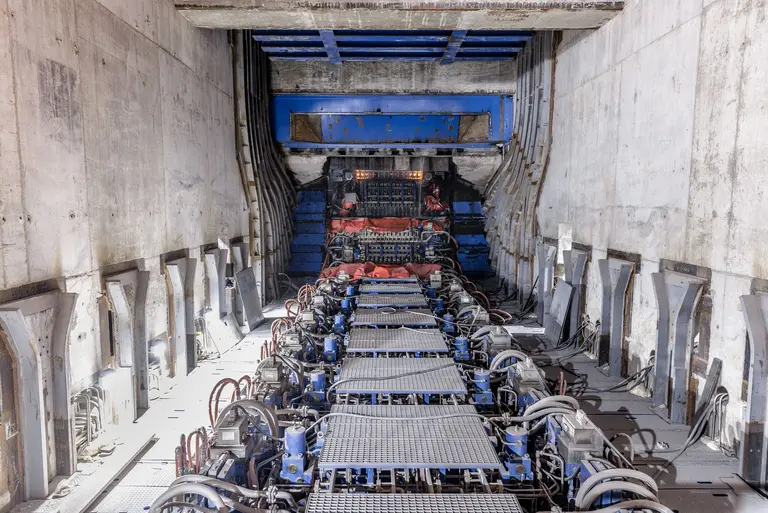
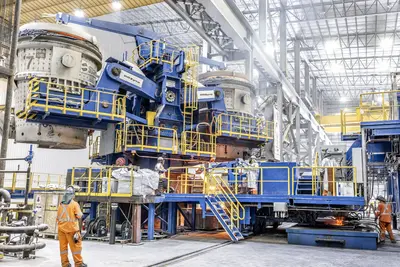
Ladle turret of the CSP® caster
The CSP® continuous caster is designed as a single-strand curved mold plant (VLB – Vertical Liquid Bending).
The CSP® caster produces slabs with 100 to 140 mm thickness.

Two powerful roughers for maximum rolling speeds and reductions

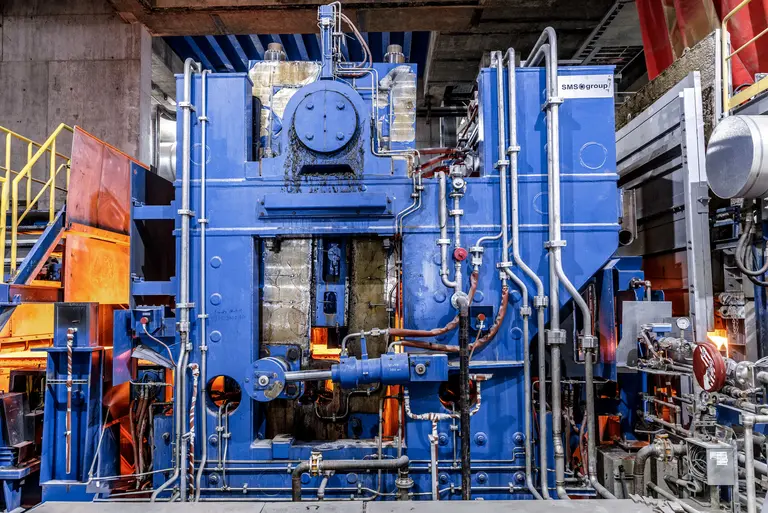
The roughing mill area consists of two non-reversing roughing stands, supplemented by two vertical edgers for higher productivity and precise width control. The high reduction per rolling pass of the roughing mill ensures the penetration of the rolled slab to its core. The entry thickness is typically 110 to 140 mm, depending on product requirements, and the transfer bar leaves the second rougher with a thickness between 35 and 60 mm. The aim of the process is to achieve a maximum degree of deformation with the minimum processing time to keep heat losses low and to avoid energy-intensive reheating. A crucial advantage is that in real batch mode, the rough-rolling speed is not limited by the downstream processes. This allows rough-rolling speeds of up to 3.5 m/s, i.e., significantly higher than with continuous TSCR concepts involving coupled mass flows.
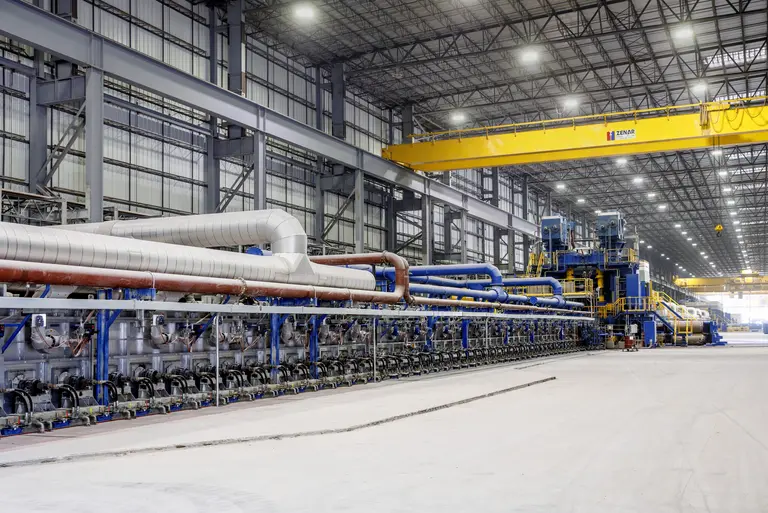
After casting, the slabs are transferred to the roughing mill via the first heated roller table.
The non-reversing stands with vertical edger are designed for high pass reductions.

Thermomechanical and real batch rolling

The transfer bar then enters the transfer bar cooler, a special cooling device that provides accurate temperature control before finishing. This is essential for guaranteeing flexibility when producing micro-alloyed steel grades with high toughness requirements (e.g., API for line pipes). This is where thermomechanical rolling is employed, which requires a defined temperature drop after roughing but before finishing to achieve the desired microstructure.

The transfer bar is conveyed over the second heated roller table. It acts as a central buffer zone between roughing and finishing. It allows: 

  • Complete decoupling of the two rolling phases.
  • Independent selection of the finishing rolling speed for precise control of the final rolling temperature requirements for the relevant product.
  • Homogeneous temperature profile over the length and width, and thus homogeneous final product properties.

Finishing mill: Six stands for high flexibility and quality

The finishing mill consists of a high-pressure descaling unit followed by six mill stands equipped with automatic pass line adjustment and active guiding systems. The entry thickness is between 35 and 60 mm, and the final strip thickness between 25.4 mm (e.g., API grades) and 1.2 mm (e.g., low carbon grades). Width, thickness, and grade changes can be performed flexibly from coil to coil, thanks to the real batch rolling mode.

All finishing stands are fitted with tried-and-tested actuators, such as our CVC® plus and work roll bending systems. Used in combination with X-Pact® Profile Contour and Flatness Control (PCFC®), flexible, efficient, and extremely precise rolling is ensured. CVC® grinding on the work rolls allows the geometry to be precisely controlled, even during changing sequences. SDI is thus able to adapt its rolling campaigns flexibly to different order situations. This is yet another major advantage compared with other TSCR concepts, which run in endless mode and therefore have wear-optimized roll grindings instead of flexible CVC® grindings in the final mill stands.

After the rolling process, the strip passes through the laminar cooling section, which features segmented control and edge masking. The cooling section is controlled by the X-Pact® Cooling Section Control system and is supplemented by the X-Pact® Microstructure Property Model, with which the ideal product properties for the final hot rolled products can be predicted.

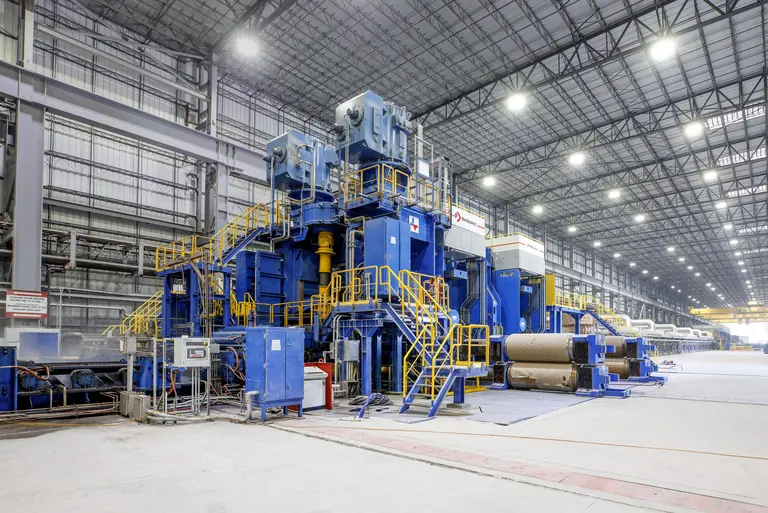
6-stand finishing mill
All finishing stands are fitted with tried-and-tested actuators, such as CVC® plus and work roll bending systems.
Downcoiler

X-Pact® automation ecosystem

At the center is SMS group’s X‑Pact® automation ecosystem. This modular software architecture interlinks every plant area within a common framework that covers both X‑Pact basic and process automation solutions. The systems are fully scalable and equipped for future functional expansions including AI‑based optimization, digital twins, and ESG‑compliant reporting tools.

The X‑Pact® Integrated Process Model (IPM) serves as the plant’s overarching system, orchestrating the individual models and optimizing the process with regard to energy consumption and product quality for API-grade production. It sets up the process prior to rolling in the most energy-efficient way while maintaining the target dimensions and properties.

A further strategic benefit of this end‑to‑end software architecture is the ability to add future functionalities without making any structural modifications, examples here include predictive maintenance, resource and energy optimization, and digitally networked supply chains.

A hard deadline was scheduled for the start of production on the new plant. The only way to get there on time was with our X-Pact® Plug & Work automation test, which employs a digital twin of the plant to create simulations and perform an exhaustive set of tests. Unlike other projects, where the customer travels to integration test facilities for several weeks, SMS implemented a fully remote testing and training approach for this project. The entire simulation was streamed to the SDI teams via VPN from Germany, including virtualized control desks, local panels, HMI system, and 3D simulation of the digital twin, enabling the customer to operate the plant from the US while the SMS team in Germany held videoconference training. The approach was so successful that it led to additional training orders and enabled the customer’s personnel to be fully fit and ready for operation when the plant came on stream.

Our goal in Sinton was clear: A plant that gives us full control over quality, throughput, and product mix.
The control room is the centrepiece of the plant control system.

Comprehensive maintenance solutions

SMS group is solidifying its role as a trusted service partner by providing comprehensive lifecycle services for the CSP® Nexus at SDI Sinton. Under an outsourcing agreement for the management and operation of the mold and segment workshop, SMS is securing reliable plant performance and long-term asset value. Standard technical services, such as inspections, repairs, overhauls, and spare parts for core components, are a central part of our service offerings. In addition, an SMS maintenance and operations expert is on hand to support the customer directly on-site, addressing day-to-day operational needs.

Milestones since commissioning

Since commissioning, SDI has validated the innovative technology under industrial conditions. In the first year of operation, the plant achieved numerous milestones in terms of productivity, product diversity, quality control, and process stability. Documented KPIs indicate not just compliance with specifications, but also the capacity of CSP® Nexus to address applications traditionally reserved for conventional hot strip mill, delivering higher energy efficiency and better homogeneity.

Notable achievements include: 

  • Four months after producing the first coil (February 2022), the line produced 25.4 mm thick coils with a width of 2,134 mm, demonstrating robust process control for heavy-gauge wide-strip production.
  • In August 2023, the caster logged a recorded peak throughput of 9.4 t/min demonstrating stable operation and a consistent meniscus level and setting another world record in high-throughput casting.
  • Real batch operation enables flexible product changes within a rolling campaign, allowing each plant section to operate within the product’s optimum process window. Key proof of maturity was the successful production of API X70 hot strip with a thickness of 18.4 mm, including verification of the mechanical properties per API 5L, PSL2 and achieved toughness values down to –40 °C.

Trailblazing technology for changing markets

The commissioning of CSP® Nexus at SDI sets a new benchmark not only for productivity, quality, and energy efficiency, but also for strategic resilience. Future industry requirements are clear: lower CO2 emissions, greater production flexibility, wider-ranging material portfolios, and reduced operating costs. CSP® Nexus is equipped to meet these demands and open up new opportunities.

The plant concept is modular: SDI’s Nexus plant was designed for future productivity enhancements, enabling capacity to be expanded beyond 4 million t/year. That makes CSP® Nexus a genuine alternative to conventional hot strip mills with respect to CAPEX, footprint, maintenance, and efficiency. With documented performance, particularly for API and HSLA steel grades, CSP® Nexus is positioning itself as a solution for growth sectors such as energy, mobility, and infrastructure.

Validated under real production conditions, the CSP® Nexus at SDI offers comprehensive, traceable process data and records that demonstrate the technology’s superiority: a scalable, digital, and decarbonizable production platform for next‑generation flat steel.

Written by

Cosimo Cecere
Sales CSP plants

Cosimo Cecere

Sales CSP plants

+49 2161 3505575
Am SMS Campus 1
41069 Mönchengladbach
Germany
Martina Quoika
Product marketing

Martina Quoika

Product marketing

Wiesenstraße 30
57271 Hilchenbach-Dahlbruch
Germany

西马克集团email服务

我们的承诺:这绝不仅仅只是发送个简讯!


是的,我已阅读数据保护公告并同意接收来自西马克集团有限公司的营销邮件。

More insights by topic

显示所有

Let's get in touch!