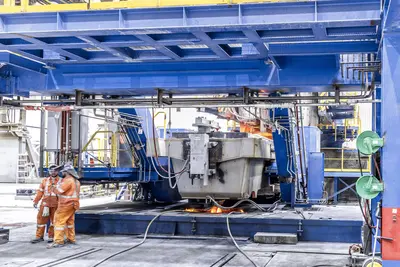
Continuous casting can be divided into three phases: startup, steady-state casting, and tailout. While conventional breakout prevention systems are designed to operate only once steady-state conditions are reached, the startup phase typically remains under manual supervision. During this time, molten steel is first introduced into the mold, the strand shell begins to solidify, and casting speed is gradually increased. This period — often extending up to around 3.5 meters of cast length — is highly dynamic and difficult to control, making early detection of potential breakouts especially complex.
As casting speeds continue to rise in modern plants, the burden on operators has increased significantly. Manual monitoring during startup is becoming ever more demanding, while interruptions at this early stage can result in substantial losses, including wasted steel and costly ladle disposal.
Extending HD mold expertise to the startup phase of casting
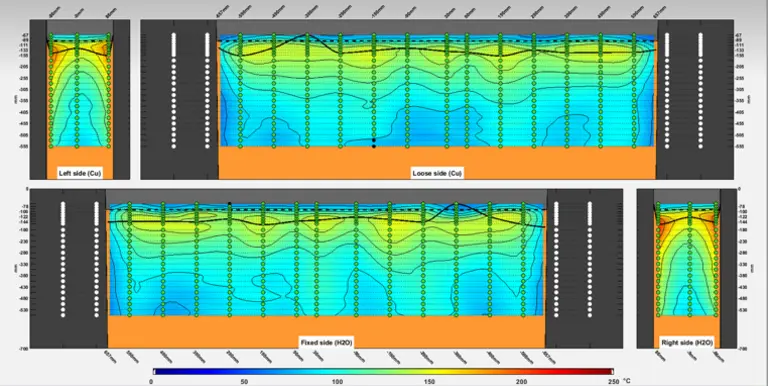
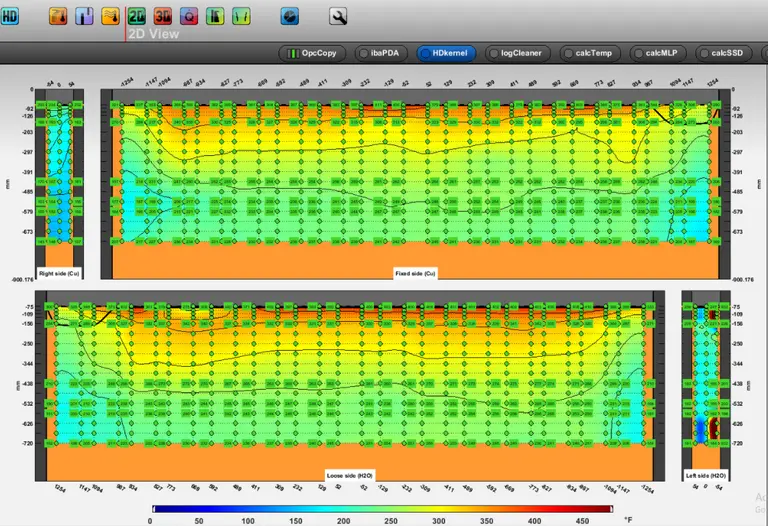
To address these challenges, SMS group has expanded the capabilities of its proven HD mold technology. Known for integrating thermocouples (HDmold TC) and fiber-optic sensors (HDmold FO+) directly into the mold, the HD mold system delivers precise, real-time insight into casting conditions. These data streams are the foundation for powerful software models that support operators in maintaining stable, high-quality casting operations.
The latest enhancement introduces a novel adaptive algorithm specifically designed for the startup phase. Unlike traditional systems that remain inactive until stable conditions are established, this algorithm enables reliable detection of sticking-type startup breakouts from the very beginning of casting.
A joint success story with SDI
The development and successful implementation of the new adaptive startup algorithm is the result of close, trust-based cooperation between SMS group and the SDI Sinton team. From the very beginning, both teams worked hand in hand — combining operational experience from the caster with SMS group’s technological and metallurgical expertise — to jointly address the challenges of startup stability in continuous casting. This collaborative approach made it possible to translate real plant requirements directly into a robust, practical solution that delivers measurable benefits in daily operation. The excellent cooperation, open exchange of data, and continuous feedback from operators were key enablers in refining the algorithm and building the confidence needed to deploy it earlier and earlier in the casting process.
Balancing human oversight and automation
During the initial meters of casting, operators retain control and can manually activate a slowdown if required, with the HD mold system acting in a supporting role. Once a defined cast length is reached — previously set at 3.5 meters — the system seamlessly transitions to automated control, autonomously generating the optimal slowdown curve when necessary. This hybrid approach combines human expertise with intelligent automation to ensure both safety and consistency.
As confidence in the system has grown, customers have progressively reduced the point at which automatic slowdown begins — from 3.5 m to 2.5 m, and most recently to just 2.0 m — demonstrating trust in the technology’s early-phase reliability.
Proven results in real operations
The benefits of the adaptive algorithm are already clear. Before its implementation, multiple startup breakouts were recorded within a ten-month period, with 40% showing typical sticking patterns. Following deployment, the system successfully detected 75% of these critical startup events while maintaining a false alarm rate of less than 1%.
Equally important, since the introduction of the new approach, customers have reported no startup breakouts with typical patterns and no extraordinary false alarms — highlighting both the precision and robustness of the solution.
A new standard for high-productivity casting
With enhanced startup stability, fewer disruptions, and reduced reliance on manual intervention, the improved HD mold system delivers tangible value: higher plant availability, improved yield, and consistently high product quality. Operators are freed to focus on other tasks, while caster owners benefit from increased efficiency and reliability.
Looking ahead, SMS group sees further potential to refine the adaptive algorithm and extend its principles to additional challenges of the casting process. What is already clear, however, is that by transforming the most vulnerable phase of casting into a controlled, data-driven operation, SMS group is helping customers meet the growing demands of modern steel production — starting strong from the very first meter.